Task Lighting Is Worth Testing for a Specific Activity
Start with one task, not a promise that brighter is always better
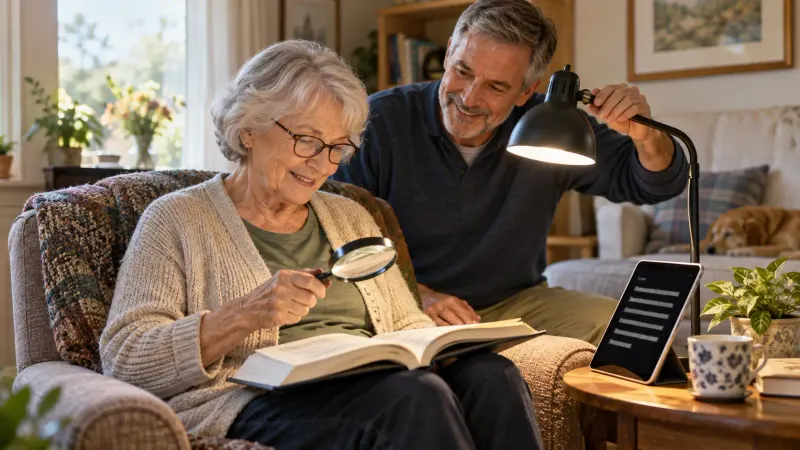
Royal College guidance describes localized task lighting for activities such as reading, telephone use, kitchen work, and eating. 1 Choose one activity that is difficult, place an adjustable lamp where you normally do it, and compare performance with the lamp off and on. Record clarity, comfort, shadows, glare, posture, and whether you can finish the task.
The National Eye Institute lists brighter lighting at home or work as one possible adaptation for people with low vision. 2 That makes task lighting a reasonable low-cost trial, not a treatment for the eye condition causing the difficulty. Judge it by the named activity rather than by how bright the room looks.
How should you choose a setting?
In a pilot study of 24 older adults with low vision from cataract or macular degeneration, performance tended to improve under brighter conditions, but the best light level varied substantially among participants. 3 The study was small and does not provide a universal target for every person or eye condition.
Use that uncertainty constructively. Try a lamp that can move and dim, keep the task and viewing distance the same, and change one feature at a time. A useful result is not “this bulb is best.” It is “this position and setting made this task easier without adding glare or an awkward posture.” For a related symptom pattern, read Preparing for a Low Vision Cooking Assessment.
Who May Benefit from a Task-Light Trial
People with a repeatable near-task problem
A good trial starts with a repeatable task in a stable place: reading mail at a desk, sorting tablets at a counter, writing a check, preparing food, or working on a hobby. Define what success means before moving the lamp. You might compare the number of words read comfortably, the time needed to find an item, or whether shadows hide the edge of the work. You can compare this topic with Deciding Which Fall Prevention Supports Fit Your Home.
Royal College guidance identifies reading, telephone use, kitchen work surfaces, and eating areas as common settings for localized task lighting. 1 The examples are starting points. The right question is whether directed light improves your task in your usual environment.
People who need control rather than one fixed brightness
When the task, time of day, or background changes, compare settings on a lamp that can be adjusted. Look for a shade that hides the source from your direct view, an arm that holds its position, controls you can find and operate, and a base or clamp that stays stable. A dimmer can make comparison easier, but it is not required for a basic test.
The Royal College guide recommends an adjustable reading lamp positioned below eye level, between the person and the material, with light directed toward the task. 1 Begin there, then adjust for your hand, magnifier, screen, or reflective surface.
People who can compare a real outcome
Pick a short test that matters to you. Use the same print, ingredients, coins, craft materials, or computer screen for each comparison. Note whether you lean closer, lose your place, make more mistakes, or stop because of discomfort. Ask another person to help move the lamp if handling it changes your posture or creates a fall risk.
The 24-person pilot measured both task performance and subjective preference, and the average results masked large individual differences. 3 Record both performance and preference.
When Task Lighting Alone Is a Poor Fit
When direct light creates glare or deep shadows
If the source is visible, reflected in a glossy page, or shining from behind your hand, move the lamp before increasing brightness. Compare a matte surface, a different angle, or a shade that blocks a direct view of the bulb. Stop the trial if the setup makes the task less comfortable or hides hazards around the work area.
Royal College guidance notes that many people with low vision experience discomfort glare even though they may also need more light for near tasks, so flexibility is important. 1 A lamp that helps one surface may be a poor fit for another.
When the problem is moving around the room or a changing visual symptom
Ask whether the difficulty concerns one work surface or the route through the room. Do not use a lamp trial to determine why vision has changed. The National Eye Institute states that an eye doctor can assess low vision during a dilated eye examination. 2 If the difficulty is new, changing, or not confined to one task, ask for that assessment before you buy more lamps.
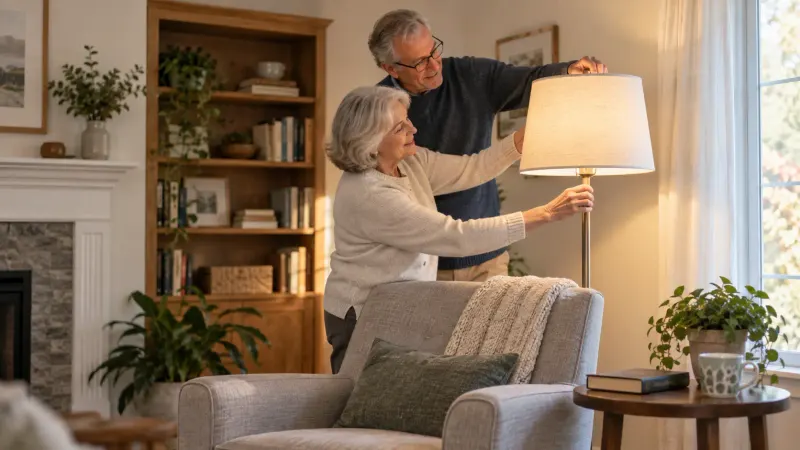
The Royal College guide distinguishes localized task light from ambient lighting used to move around and locate objects, and it emphasizes even lighting through the home. 1
How to Test Lighting and Discuss the Result
Build a one-task comparison
Write down the task, room, time, material, viewing distance, and current correction. First try the task under the usual lighting. Then direct the lamp at the work while keeping other conditions the same. Change the distance or brightness once, and repeat. Use ordinary descriptions such as “the price line stayed visible” or “the glossy package reflected the bulb.”
Bring two or three observations to an eye-care or low-vision visit. A photograph of the setup can show the lamp angle, window, chair, and work surface. Avoid using a phone photo to judge brightness; use it only to document placement.
Ask whether another adaptation should be paired with light
The National Eye Institute lists magnification and increased contrast alongside brighter lighting as possible low-vision adaptations. 2 The Royal College guide describes home adaptations that combine good lighting, contrast enhancement, and enlargement. 1
Ask whether larger print, a reading stand, a contrasting cutting board, screen settings, or a magnifier would make the same task easier. If a magnifier has its own light, compare that combination with the separate lamp rather than stacking several changes without a clear result.
Ask about vision rehabilitation when daily activities remain difficult
The National Eye Institute advises asking an eye doctor about vision rehabilitation when vision loss interferes with everyday activities. 2 Bring your task list, current glasses, aids, and lighting notes so the discussion begins with the activities you want to regain or sustain.
A meta-analysis of 52 randomized trials describes low-vision rehabilitation as highly tailored and found that pooled effects on activities of daily living were not consistently better across all rehabilitation approaches. 4 This supports realistic goals and individualized testing rather than a guarantee from any single adaptation.
How Directed Light Changes the Task
What changes at the work surface?
Ambient light is the general room light. Task light adds a directed source at the work surface. Moving an adjustable lamp changes which part of the page or object is illuminated and where shadows fall. Keep the task within the lit area and check the surrounding room before standing or walking away.
The Royal College guide states that magnifiers may not be necessary for certain tasks when illumination is adequate. 1 Test the actual task before deciding whether the lamp supplements an existing aid.
Position can matter as much as the lamp label
The Royal College guide recommends placing an adjustable reading light below eye level and directing it toward the material. 1 Shift it to the opposite side of the hand that blocks the beam, then look for new reflections from screens, plastic packaging, polished counters, or glossy paper. Secure the cord outside the walking path and confirm that the base stays steady when the arm moves.
The Royal College guide recommends adjustable LED lighting for prolonged reading because it can provide even light with little heat. 1 That is practical guidance, not proof that one bulb color, brand, or lamp style is best for everyone.
What happens when you look up?
Royal College guidance notes that people with poor vision may take longer to adapt between light and dark and recommends keeping home light levels even. 1 Compare how it feels to look from the bright task to the room, doorway, or floor. If the transition hides surrounding objects, adjust the room light as part of the setup.
What Task Lighting Can and Cannot Do
What can a lamp trial tell you?
The National Eye Institute lists brighter lighting as one possible small change that may help a person with low vision see better. 2 Record whether the selected task becomes clearer, more comfortable, or easier to finish. Do not use that result to infer a diagnosis or change eye treatment.
Use task performance as the outcome, not a promise that the eyesight itself has improved. Keep disease treatment and scheduled eye care separate from the lamp trial.
What does the evidence leave uncertain?
The small lighting pilot found substantial person-to-person variation in the light level associated with the best performance. 3 The broader rehabilitation meta-analysis also found heterogeneity because programs combine different optometric and therapeutic components. 4
Choose a lamp you can return or reposition, test it before changing the whole room, and keep the successful setting written down. If the result is mixed, take the notes to an eye-care or low-vision professional rather than assuming that a more expensive lamp is the next step.
When to Seek Eye Care
What if a red eye comes with light sensitivity?
In adults with an acute red eye, a systematic-review summary identifies light sensitivity as one of the best predictors of serious eye disease requiring prompt referral. 5 An acute red eye with light sensitivity warrants prompt contact with an eye-care service. 5 Describe both findings and ask whether you should be examined the same day. Do not substitute a lamp adjustment for that contact.
What if task difficulty persists?
The National Eye Institute states that low vision can be assessed during a dilated eye exam and recommends vision rehabilitation when vision loss gets in the way of everyday activities. 2 Bring the difficult-task list, glasses, magnifiers, and lighting notes. Ask what the examination can treat, what can be supported through rehabilitation, and which task should be tested next.
Who can assess the problem?
The National Eye Institute advises asking an eye doctor about vision rehabilitation when vision loss interferes with daily activities. 2 If the main question is how to perform tasks with established vision loss, ask whether low-vision rehabilitation fits your needs. The National Eye Institute says rehabilitation can include home-setup guidance, magnifier training, and help with device settings. 2
Questions about Choosing and Positioning a Task Light
Does everyone with low vision need a brighter lamp?
In a 24-person pilot, brighter conditions tended to improve task performance, but the useful level varied substantially by participant. 3 Test one meaningful activity at several settings and record both performance and comfort. If more light creates glare or an awkward posture, change the angle or setting rather than treating maximum brightness as the goal.
Where should I place a lamp for reading?
Royal College guidance recommends an adjustable lamp below eye level, between the reader and the material, with light directed at the task. 1 Move it enough to prevent your hand, head, or magnifier from blocking the beam. Check for reflections on glossy pages. Keep the base stable and the cord out of the route before settling on the position.
Is an LED lamp always best?
The Royal College guide favors adjustable LEDs for prolonged reading because they can provide even light with little heat. 1 Compare brands, color settings, and brightness on the task that matters. Use familiar reading material under ordinary conditions, and include glare, control access, stability, and comfort in the decision rather than shopping by bulb label alone.
How do I know whether glare is the problem?
Look for a visible bulb, bright reflection, washed-out print, or discomfort that appears when the lamp is aimed at the work. The Royal College guide notes that people with low vision may need more near light while also experiencing discomfort glare. 1 Change the angle, shade, surface, or brightness one at a time and record the result.
Should the rest of the room stay dark?
Royal College guidance recommends even home lighting because people with poor vision may have longer light-dark adaptation. 1 Keep enough ambient light to see the work area, floor, doorway, and route away from the task. Compare the transition when you look up. If surrounding objects disappear against the bright task, include room lighting in the plan.
Questions about Results and Next Steps
Can task lighting replace a magnifier?
The Royal College guide states that magnifiers may not be necessary for certain tasks when illumination is adequate. 1 Compare the task with the lamp alone, the magnifier alone, and the combination if you can do so safely. Record which setup lets you complete it comfortably. Bring the results to a low-vision visit if no setup is workable.
How long should I test a lighting setup?
Use it long enough to repeat the real task on more than one ordinary occasion, but do not chase a fixed number of days. Keep the task, correction, and material similar while changing one lighting feature. Record accuracy, time, posture, comfort, glare, and whether you finished. A consistent functional result is more informative than an impression from looking at the lamp.
What if the lamp helps reading but not cooking?
Keep separate settings for separate tasks. Reading and food preparation use different surfaces, distances, hand positions, and room routes. The pilot reported that most participants showed a large effect of lighting on performance in at least one task. 3 Note what helped each activity, then ask whether contrast, enlargement, or a broader home assessment would address the remaining difficulty.
When should I ask about vision rehabilitation?
The National Eye Institute recommends asking about vision rehabilitation when vision loss interferes with everyday activities. 2 Bring examples such as reading, cooking, medicine management, computer use, or moving through the home. Ask for help matching lighting, contrast, magnification, device settings, and training to your priority tasks rather than expecting one lamp to solve every difficulty.
Questions to Ask Your Doctor
- Could an updated correction or treatable eye problem be affecting this task?
- Is directed task light a reasonable first trial for this activity?
- Which task and outcome should I compare at home?
- Could glare, reflections, or uneven room light be limiting the result?
- Should I combine the lamp with magnification, contrast, or a reading stand?
- Would low-vision rehabilitation or a home assessment help?
- What change in vision or eye symptoms should prompt an earlier call?
Sources
- The Royal College of Ophthalmologists (2021). Low Vision Guide.
- National Eye Institute (2025). Low Vision.
- Lighting Research & Technology (2010). A Pilot Study of Lighting and Low Vision in Older People.
- Medicine (2021). Low Vision Rehabilitation in Improving the Quality of Life for Patients with Impaired Vision: A Systematic Review and Meta-Analysis of 52 Randomized Clinical Trials.
- American Family Physician (2016). Best Approaches to Physical Diagnosis of Acute Red Eye.