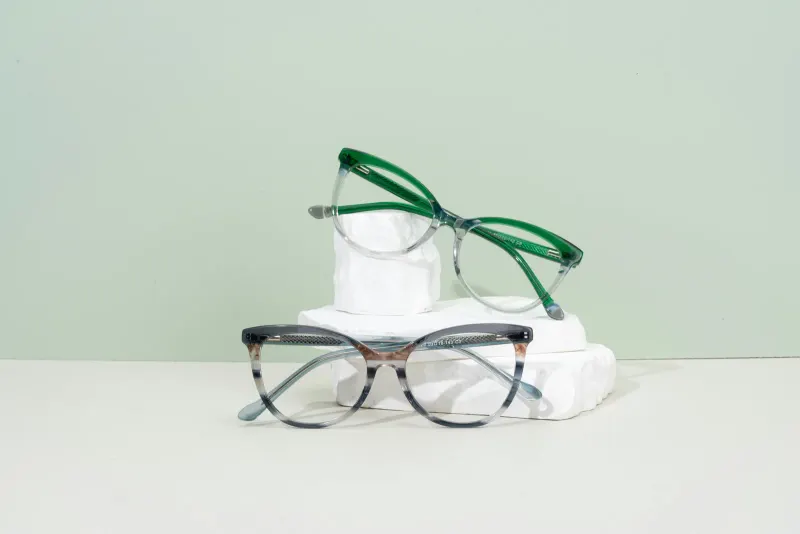

Optical centering means positioning each lens so its intended viewing areas align with the wearer's pupils and the way the frame sits. The key measurements may include monocular pupillary distance, fitting height, frame dimensions, tilt, and vertex distance. The stronger or more complex the prescription, the more a small positioning error can matter. For a related symptom pattern, read When a Complex Glasses Prescription Needs Closer Review.
Good centration does not require every gaze to pass through one physical point. Progressive and other specialty lenses contain several functional zones. The goal is to place the lens design where the eyes can use those zones comfortably in the chosen frame.
Optical centering matters because eyeglass lenses are designed around a specific point. If that point does not line up with how the glasses sit on the face, vision may feel strained, distorted, or less clear than expected.
The issue is not just the prescription written by the eye doctor. Frame choice, pupillary distance, fitting height, lens material, lens design, and how the frame rests on the nose and ears all affect the final experience.
What matters first for optical centering glasses?
Optical centering aligns the lens design with where the eyes look through the frame.
- Progressive, bifocal, prism, and stronger prescriptions are especially sensitive to measurement error.
- Frame adjustment can change how the lenses line up with the eyes.
- Sudden vision loss, new double vision, eye pain, or neurologic symptoms should not be blamed on glasses.
Why Optical Centering Matters
A lens bends light based on its power and shape. Looking through the wrong part of the lens can create unwanted prism, blur, swim, or distortion. People with stronger prescriptions may notice small measurement problems more quickly.
Progressive lenses are especially sensitive to centering because the wearer uses different parts of the lens for distance, intermediate, and near vision. A few millimeters can affect whether the clear areas land in the right place.
Optical quality also depends on how the frame sits after daily wear. A frame that slides down the nose or tilts unevenly can make a technically correct lens feel wrong.
What does glasses measurement review measure?
The purpose of glasses measurement review is to compare pupillary distance for one eye and both eyes with fitting height for progressive, bifocal, or task-specific lenses. That glasses measurement review comparison helps the clinician decide whether the result answers the optical centering glasses question or needs confirmation from another part of the examination.
Interpret glasses measurement review alongside frame tilt, wrap, vertex distance, and stability and whether the optical center matches the way the patient actually wears the frame. When the glasses measurement review findings conflict, review acquisition quality and consider a repeat or different method before accepting the first output.
Describe the daily task connected with pupillary distance for one eye and both eyes, and note whether the change is stable, intermittent, or worsening. That history gives glasses measurement review a functional context without asking the measurement to diagnose more than it can show.
- Pupillary distance for one eye and both eyes
- Fitting height for progressive, bifocal, or task-specific lenses
- Frame tilt, wrap, vertex distance, and stability
- Whether the optical center matches the way the patient actually wears the frame
What can glasses measurement review results establish?
Not every problem with new glasses is caused by optical centering. Prescription change, adaptation, dry eye, cataract, binocular vision issues, and lens design can also cause symptoms.
A good troubleshooting visit checks both the glasses and the eyes. The frame may need adjustment, measurements may need review, or the prescription may need to be rechecked.
Adaptation should be reasonable. If stairs feel unsafe, the floor swims, or reading is only clear through an awkward head position, the glasses should be evaluated rather than endured indefinitely.
- Ask what the result means for your specific diagnosis.
- Ask whether the finding is new, stable, or uncertain.
- Ask whether repeat testing or imaging is recommended.
- Ask what symptoms should prompt faster contact before the next visit.
What happens during glasses measurement review?
A troubleshooting visit may start with checking the prescription in the lenses. The optician or clinician can then measure where the pupils sit in the frame and whether the frame is level, stable, and adjusted to the face.
For progressives, the team may mark the fitting cross and compare it with the actual pupil position. For high prescriptions, they may also consider vertex distance, pantoscopic tilt, wrap, and lens material.
If measurements are correct, the discussion may move to lens design, adaptation, dry eye, cataract, or eye teaming. The goal is to find the actual cause rather than blaming the patient for not adapting.
- Bring the glasses that bother you and any older pair that felt better.
- Describe whether the problem is distance, computer, reading, stairs, or side vision.
- Do not bend the frame yourself before it is checked.
- Ask whether the lenses were verified against the written prescription.
When do symptoms connected with optical centering glasses need faster care?
Glasses fit problems are usually not urgent. Seek faster eye care if blur is sudden, one eye loses vision, double vision is new, eye pain occurs, or neurologic symptoms appear.
For why optical centering matters in glasses, an abrupt or severe change matters more than the scheduled testing plan. For glasses measurement review, use the warning signs above to choose prompt or urgent care, and do not wait for a routine glasses measurement review appointment when vision or safety is changing quickly.
How glasses measurement review findings shape follow-up
A glasses recheck should compare monocular and binocular pupillary distance, fitting height, frame position, vertex distance, tilt, and wrap with the way the frame is actually worn. For glasses measurement review, a later result matters only when its quality and context make comparison with the baseline credible.
Bring earlier reports and explain whether frame tilt, wrap, vertex distance, and stability changed between visits. That glasses measurement review record gives the clinician a concrete way to connect the glasses measurement review record with symptoms, function, treatment response, or the need for another test.
It is also fair to ask how glasses measurement review will change decisions today. For glasses measurement review, the answer may be treatment, a cleaner baseline, a safer monitoring interval, a referral, or a repeat test under better conditions. That glasses measurement review context makes the next step clearer without turning the visit into a pass-fail exercise.
If the glasses measurement review finding affects work, school, sports, reading, driving, or home safety, say so clearly. Functional details help the clinician connect optical centering results with practical advice and realistic follow-up timing.
Questions people ask about optical centering glasses
Can wrong centering cause headaches? It can contribute to strain in some people, especially with stronger prescriptions or progressives.
Should I wait weeks to adapt to uncomfortable glasses? Some adaptation is normal, but severe distortion, nausea, or unsafe vision should be checked sooner.
Is online pupillary distance measurement enough? It may work for some single-vision glasses, but complex lenses often need more precise measurements.
Readers leaving Why Optical Centering Matters in Glasses can continue with How Pupillary Distance Problems Affect Glasses, which addresses a distinct step rather than repeating this page.