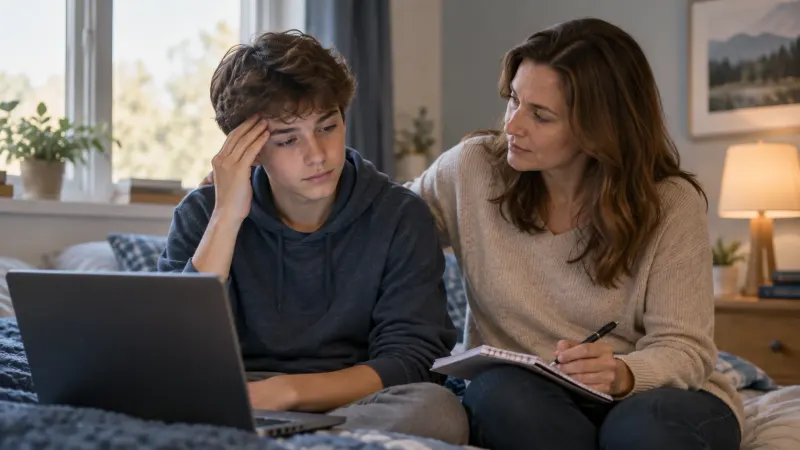

Choose the right timing for an eye-care call
Recurring close-work symptoms merit an eye exam
Contact your child's eye doctor when double vision or blur keeps coming back during reading, homework, or another close task. Report headaches, tired eyes, dizziness, or a change in reading distance that occurs with the task. Convergence excess means the eyes point more inward at near than at far. It is a binocular vision pattern (a pattern in how both eyes work as a pair). An eye exam must show whether that pattern explains the concern.
Sudden constant double vision needs urgent assessment
Seek urgent care now if double vision starts at once and stays present. Use the same route for sight loss, pain with eye movement, or a fast change in eye position. Do not wait for a routine office slot or label the change as convergence excess. Another condition may cause the same pattern and require a different form of care.
Severe headache with nerve changes requires emergency care
Use emergency care at once when a severe headache comes with weakness, numbness, speech trouble, fainting, or confusion. Doctors call these neurologic symptoms (changes that may involve the brain, spine, or nerves). A routine eye visit cannot replace emergency care for this pattern. Tell the emergency team when the eye or sight change began. For a related symptom pattern, read Eye Changes with Accommodative Excess That Need Attention.
Changes after a major head injury should not wait
Seek urgent care when double vision follows a major head injury. The same advice fits vision loss or a new eye turn. Tell the team how the injury took place. Add the time when the sight change began. Do not test the child's eye aim or ask them to push through symptoms.
Observe the child without running home tests
Record what happens during the task
Note whether the concern comes up during reading or homework. Drawing gives useful context too. Record the task that brought on the symptom. Note the change after rest. These facts describe the setting without turning your note into a diagnosis.
Use the child's own description
Write down the child's words for blur or double vision. Add words for headache or strain. Note if the child moves the page closer or farther away. Record the action without guessing at its cause. Your view and the child's report can differ, and both can help the exam.
Avoid photo checks and practice exercises
Do not use home eye-aim tests, prisms, web exercises, or repeat photo checks. Blur, headaches, and close-work strain can overlap with a need for glasses, dry eye, migraine, learning concerns, or nerve problems. An eye doctor needs a full exam with near and distance tests to sort the causes. A home result cannot select a diagnosis or treatment.
Create a parent observation note for close work
Capture a short factual pattern
Build a note that describes the concern without a label. Use a new entry when the setting changes. Write the child's words in quotes when you can. Add facts from an adult. Give the eye office enough detail to know why you called.
- The close task the child was doing
- The setting and time of day
- What the child said or did
- Whether the concern recurs
- What made the child stop or change the task
- The person who observed the event
Add school observations without drawing conclusions
Ask a teacher what they saw during reading or desk work. Request one clear example from a usual task. “The child closed one eye” tells more than a broad label. School trouble cannot prove an eye or learning disorder. The eye doctor can assess the pattern during an exam.
Bring the note into the first phone call
Tell the office that close-work symptoms keep coming back. Name double vision, blur, headache, an eye turn, or a change in reading distance. Give the office the task, start time, and effect on the child. Lead with any sign that began at once, remains constant, or has grown. Report sight loss, pain with eye movement, nerve symptoms, and a recent head injury before you accept a routine slot.
Prepare for a complete evaluation
Expect more than a reading check
An eye doctor may check how well the child sees. The exam can show if glasses may help. The doctor may test focus and eye aim at near and far. The visit can also cover eye health and past symptoms. These parts help sort convergence excess from other causes of close-work trouble.
Keep convergence excess distinct from other conditions
Convergence excess and convergence insufficiency are different eye-aim patterns. Similar symptoms do not make them the same. Use a term after a clinician has found the pattern. Before then, stick to what the child says and what adults see. A symptom list cannot choose the right diagnosis.
Let the examination guide treatment questions
The exam may lead to prescribed glasses or another care plan. Do not start exercises, patching, prism, or bifocals from web advice. Prism (a lens feature that changes the path of light) needs a clinician's measurements and plan. Ask what exam finding each care step targets, how the team will track change, and which signs should bring another call.
Parent questions about convergence excess concerns
Does an inward eye turn belong in the first call?
Yes, tell the office if an eye turns inward during close work. Note if the eyes look straight at a distance. Say whether the turn is new or keeps coming back. Report a turn that seems to grow. A clinician must measure eye aim before naming the pattern.
Can headaches alone show that my child has this condition?
Headaches alone cannot identify convergence excess. Eye and non-eye problems can cause them. A child's doctor may need to assess the full picture. Record when the pain starts and what task came first. Add any blur, double vision, or other symptom that comes with it.
What should I ask the teacher to document?
Ask for the task and the action the teacher saw. Add the child's own words. Note how the concern changed class work or play. Do not ask the teacher to test sight or name a disorder. Share the facts with the eye doctor and the child's main doctor when needed.
Should I ask my child to read until the symptom appears?
Do not bring on a symptom to collect proof. Record concerns that arise during usual tasks. Let the child stop when the task causes pain or strain. The eye doctor can choose safe tests in the exam room. A home test adds risk of a false label without helping the child.
Will an eye examination diagnose a learning problem?
An eye exam checks sight, eye health, focus, and eye aim. It does not serve as a learning test. Reading trouble can stem from more than one health or learning cause. Keep eye findings with the eye-care team. Route learning questions to the school and health experts who handle them.
What should I ask when scheduling the visit?
Ask what visit fits double vision, blur, headache, or an eye turn. Tell the office when the concern occurs during close work. Lead with any urgent sign before you take a routine slot. Bring the note and the child's current glasses. Add health history and school examples that may help the exam.
Share your observation note with the eye doctor
Call the child's eye doctor with the task, setting, symptom pattern, and the child's own words. Ask which type of exam fits the concern. Use urgent care for a sign that begins at once, grows fast, or seems severe.