
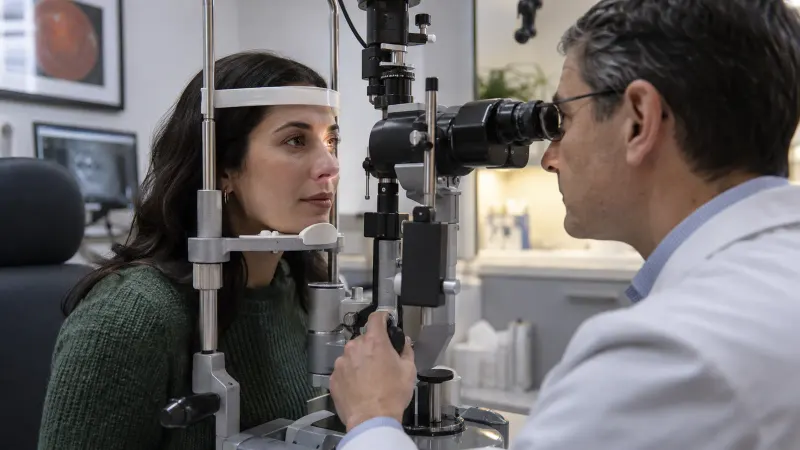
A Clear Follow-Up Plan for Salzmann Nodular Degeneration
What should you do between cornea visits?
Keep the schedule your cornea specialist gives you. Note changes in comfort and useful vision. Bring the glasses, contact lens details and eye products you use. Salzmann nodular degeneration can be symptom-free or can cause a foreign-body sensation and blurred vision. 1 Use the visit to ask how your notes compare with the vision test and eye exam.
What should each visit answer?
Leave knowing what is stable, what changed, when to return and when to call earlier. Doctors examine Salzmann nodules with a slit lamp. A corneal map or a scan called AS-OCT may add details about eye shape and nodule depth. 1 2 Ask which test is useful for the question at this visit.
What Salzmann Nodular Degeneration Is
Where are the nodules?
Salzmann nodular degeneration is a condition of the cornea, the clear front surface of the eye, with raised whitish-gray or bluish nodules that may occur in the peripheral or central cornea. The nodules lie beneath the surface epithelium and above or near Bowman's layer, and their location can influence visual effects. 1
Why can the condition affect vision?
Salzmann nodules can change corneal shape and cause irregular astigmatism, central flattening or a shift in refraction, especially when they affect the visual area. 1 2 At follow-up, ask how the eye-chart result and corneal measurements fit together, and whether another finding could affect a glasses change.
Does every nodule cause symptoms?
No. Salzmann nodules may be asymptomatic, or they may be linked with foreign-body sensation and blurred vision. 1 A 2024 review also reports pain, tearing and recurrent corneal erosions in some patients. 2 Use your own visit results, rather than another person's experience, when writing questions for your specialist.
What Is Known About Causes and Associations
Is there one proven cause?
The exact cause and mechanism of Salzmann nodular degeneration are not fully understood; reviews describe a complex, multifactorial process involving the corneal surface and wound-response tissues. 1 2 Do not treat a reported association as proof that one habit or past event caused your nodules.
Which eye conditions have been reported with it?
Reported associations include dry eye disease, chronic blepharitis or meibomian-gland dysfunction, long-term contact lens wear, prior inflammation or trauma, and previous corneal or other eye surgery. 1 2 The co-existence of a common condition such as meibomian-gland dysfunction or contact lens use with Salzmann nodules does not necessarily imply causation. 1 Tell the specialist about past eye conditions, operations, contact lens use and current surface care so the examination has the right context.
Can other conditions look similar?
Salzmann nodular degeneration can be misdiagnosed, and reviews emphasize clinical correlation because other corneal scars or surface lesions can overlap in appearance. 1 2 If the diagnosis or a new finding is uncertain, ask what evidence supports it and whether imaging or another opinion would clarify the plan.
Changes to Record Between Visits
Track comfort and vision separately
A 2024 review reports pain, foreign-body sensation, tearing, recurrent corneal erosions and reduced visual acuity among presentations of Salzmann nodular degeneration. 2 Use two short columns. In one, note irritation or discomfort. In the other, note the task affected by blur, glare or distortion. Separating them helps the specialist see whether comfort and visual function changed together.
Describe the effect on a real task
Write a concrete example such as, “Fine print is less clear in my usual glasses,” or, “The eye feels scratchy after two hours of reading.” Add which eye, when it began, whether it is gradual or sudden, and what you were wearing or using. Do not label a symptom as nodule growth or recurrence; let the examination answer that question. For a related symptom pattern, read Symptoms to Bring up at a Fuchs Dystrophy Visit.
Include contact lens and eye-product changes
Bring the names of drops, ointments and contact lens products you use, including the schedule your clinician gave you. Note any change in contact lens tolerance or wearing time. Do not stop or change a medicine without talking to the prescribing clinician. 3 Ask how a treatment should be used and when it should be reviewed.
What the Specialist May Compare
Vision and refraction
Salzmann nodules can induce irregular astigmatism and alter refractive power. 1 Bring the glasses or lens details you actually use. Ask whether the team will compare visual acuity, refraction or both, and whether a measured change is likely related to the corneal surface or another eye finding.
Slit-lamp examination
Diagnosis is mainly clinical with a slit lamp, where the clinician can assess the color, number, shape and location of the corneal nodules. 1 2 Ask the specialist to describe the finding in plain language and identify which feature will be compared next time. Avoid trying to reproduce this examination with a mirror.
Corneal topography or tomography
Corneal topography and tomography can assess irregularity and astigmatism caused by Salzmann nodules and compare these features after surgery. 1 Ask whether a scan is useful at this visit. If one is ordered, ask which measurement matters and whether the image is being compared with a prior test.
Anterior-segment OCT
Anterior-segment OCT can show the morphology and depth of a Salzmann nodule and may help when the clinical diagnosis or treatment plane is uncertain. 1 2 Ask what the scan adds beyond the slit-lamp view. A scan should answer a defined clinical question rather than serve as a home progress score.
Turn Follow-Up Into a Fair Comparison
Use the same information each time
Bring your symptom note, current correction, eye-product list, procedure history and any change in contact lens use. Ask whether the team has the earlier photographs or scans available. Use similar task examples from one visit to the next. A fair comparison is more useful than trying to remember whether the eye “felt worse” months ago. You can compare this topic with Monitoring Herpes Zoster Eye Disease During Treatment.
Ask what the visit is monitoring
Ask the specialist to name the result being compared at this visit and show you where it appears in the record. If the plan is observation, write down what observation includes and what would change the plan. For another care decision in this area, see Fungal Keratitis Symptoms to Report Between Visits.
Do not replace the specialist's interval with an online timetable
Use the return date your specialist gives you. If it is not clear, call the office and ask them to confirm it. Do not choose your own interval from an online article or procedure study.
After a procedure, use the surgeon's plan
A 2025 retrospective PTK study compared best-corrected vision, refraction, corneal power, astigmatism, higher-order aberrations, corneal density and thickness before and after treatment. 4 That study illustrates the range of measurements used in research. It does not supply a personal visit schedule or postoperative medicine plan. Follow the surgeon's written instructions.
How Monitoring Connects to Management
When may observation or surface care be used?
Treatment choice depends on symptoms and disease extent. Reviews describe conservative management for people with few or mild symptoms, while surgery is used for a minority with significant visual effects or symptoms that continue despite conservative care. 1 2 Ask which surface treatments, if any, apply to your eyes.
Which procedures may be discussed?
Reported procedures include superficial keratectomy to remove nodules, phototherapeutic keratectomy to smooth the corneal surface, and less commonly lamellar or penetrating keratoplasty for severe or recurrent disease. 1 2 This page cannot identify whether a procedure is appropriate. Ask what problem it is meant to solve and what follow-up it requires.
Why might the plan change?
Management choices are guided by symptoms, disease extent, nodule location and visual effect. 1 2 Ask the specialist to connect the recommendation to the measured finding. If surgery is proposed, ask about alternatives, expected benefit, healing, uncertainty and recurrence.
Keep a Short Monitoring Record
Use a one-page visit summary
Record the date, vision in each eye if the clinic provides it, the main corneal finding, any scan used, the treatment plan, the next appointment and the earlier-call triggers. Keep procedure reports with the longer medical record. A one-page summary helps you see the sequence without trying to interpret the images yourself.
Avoid overchecking the eye
Use a mirror or phone photo only to record what prompted your question. Do not use it to decide whether the nodule changed. Note the symptom and its effect on a task, then bring the question and any photo to the specialist.
Plan for missed visits or changing symptoms
If you miss a visit, call to ask when it should be rescheduled. If symptoms change before then, describe the new pattern and ask whether the date should move forward. Keep the routine and urgent phone numbers with your eye-product list so you do not have to search for them while uncomfortable.
Recurrence and a Realistic Outlook
Can nodules return after removal?
Yes. Published reports document recurrence after superficial keratectomy, PTK and corneal transplantation. A review summarized recurrence rates ranging from zero to 31 percent across small, different surgical series. 1 Ask which evidence is relevant to the procedure being discussed for you.
What did the recent PTK study show?
The 2025 retrospective study included 69 eyes from 54 patients treated with debridement and PTK and reported changes in vision, refraction, corneal astigmatism, aberrations and corneal density during follow-up. It studied treated eyes at one center and did not compare PTK with observation or another procedure. 4 Use it as population evidence, not an individual outcome promise.
What is a useful goal for follow-up?
A useful plan identifies which change would make observation insufficient and which measurement will be repeated. Recurrence is possible after treatment, while some Salzmann nodules are asymptomatic. 1 Your own sequence of symptoms, vision and corneal findings is more useful than one isolated percentage.
When to Call or Seek Urgent Eye Care
Use emergency care for sudden major vision loss
Acute vision loss is a clinical emergency that needs prompt diagnosis and early management. 5
Severe eye pain with sudden vision loss is an emergency
Severe eye pain with sudden vision loss is a red flag that needs emergency assessment. 5 Do not assume the known corneal nodules explain it. Tell the clinician about redness, recent contact lens wear and recent eye treatment.
Contact the cornea clinic about a persistent functional change
MedlinePlus advises seeing a provider for problems with eyesight. 3 If blur or another functional change is new, persistent or interfering with an important task, call the cornea clinic and ask whether the specialist wants an earlier visit. Describe the eye, timing, speed of change, pain or redness, and recent treatment. Follow any more specific instructions already given after a procedure.
Keep routine follow-up when symptoms are stable
Some Salzmann nodules cause no symptoms, and recurrence can occur after treatment. 1 Attend the planned visit even if the eye feels unchanged. Bring the same record and correction so the team can compare like with like. Ask the cornea specialist or ophthalmologist who should handle routine questions and where to call after hours.
Common Questions About Salzmann Follow-Up
Can I tell whether a nodule has grown by looking in a mirror?
No. Clinical assessment uses slit-lamp examination, and corneal topography or AS-OCT may add information about shape or depth. 1 2 Do not use a mirror view to label a change. Record what you noticed, when you noticed it and any effect on a real task, then let the specialist compare the clinical findings.
Does every gritty feeling mean the condition is progressing?
No. A foreign-body sensation is reported with Salzmann nodules. 1 Salzmann nodular degeneration is also reported with several ocular-surface conditions. 1 Record the sensation without labeling it as progression. Tell the specialist when it occurs, what else changed and which eye products you used. Note whether vision changed too.
Why might my glasses prescription change?
Salzmann nodules can alter corneal shape, create irregular astigmatism and change refraction. 1 Bring old and current glasses when useful and ask whether the team wants the corneal surface assessed before a new prescription is finalized. Ask whether another eye condition could also affect the change. Record which correction helps.
Do I need corneal imaging at every visit?
Not necessarily. Topography can assess corneal irregularity and astigmatism, while AS-OCT can characterize the nodule's depth and morphology. 1 The specialist decides whether repeating a test will answer a useful question. Ask what would be compared, whether an earlier result is available and how the new result could change the plan.
Can stable symptoms mean I can stop follow-up?
Do not stop on your own. Salzmann nodules can be present without symptoms, so symptoms alone do not describe every corneal finding. 1 Ask the specialist whether the condition is stable, which result supports that conclusion and when another comparison is needed. If the clinician changes the interval, write down the new date and the symptoms that should prompt an earlier call.
Questions About Treatment and Recurrence
Does everyone with Salzmann nodules need surgery?
No. Reviews describe conservative management for asymptomatic or mildly symptomatic disease, and surgery for a minority with significant visual effects or symptoms that continue despite conservative treatment. 1 2 Ask which finding is driving your plan, what observation includes and how the team will judge whether it remains suitable. Write down the next comparison point.
Can surgery guarantee that the nodules will not return?
No. Recurrence has been reported after several surgical approaches, and the reported frequency varies across small studies and procedures. 1 Ask the surgeon which recurrence evidence best fits the proposed procedure, what other surface conditions need care, how recurrence would be detected and what later visits are planned. Keep those dates with your procedure record.
Should I use a published recurrence percentage for my own risk?
No. The 2019 review reported widely varying recurrence across small surgical series with different procedures and follow-up. 1 Ask the specialist which evidence applies to the procedure being discussed, what is known in your case, what remains uncertain and which monitoring plan follows. Write the answer next to the procedure name.
What should I bring after a corneal procedure?
Bring the procedure report if the clinic does not have it, your current eye-product list, correction, symptom timeline and the surgeon's written restrictions. Do not stop or change a medicine without talking to the prescribing clinician. 3 Note any missed dose or unexpected change, and ask which healing measurements are being compared and whether the next visit remains at the planned time.
Preparing for the Next Cornea Visit
What if another eye condition also affects my vision?
List the other diagnosis and bring relevant reports. The 2025 PTK study analyzed additional visual-acuity limitations separately because other eye disease can affect measured vision. 4 Ask the specialist which part of the current change is likely corneal and which part may need another examination. Avoid assuming every visual change comes from Salzmann nodules.
Questions to Ask Your Cornea Specialist
- What is stable, and what has changed since my last visit?
- Which symptom or task change should make me call earlier?
- Does the nodule affect my visual area or corneal shape?
- Do I need topography, tomography or anterior-segment OCT today?
- If we are observing, what finding would change the plan?
- If a procedure is discussed, what are the alternatives and recurrence evidence?
- When is my next visit, and where should I call after hours?
Sources
- Clinical Ophthalmology (2019). Salzmann nodular degeneration: prevalence, impact, and management strategies.
- Journal of Clinical Medicine (2024). Salzmann Nodular Degeneration in Ocular and Systemic Diseases.
- MedlinePlus Medical Encyclopedia (2024). Vision problems.
- Journal of Clinical Medicine (2025). Visual, Topographic and Aberrometric Outcomes After Phototherapeutic Keratectomy for Salzmann Nodular Degeneration.
- Cureus (2026). A Systematic Approach to Managing Acute Visual Loss: A Comprehensive Review of Literature.