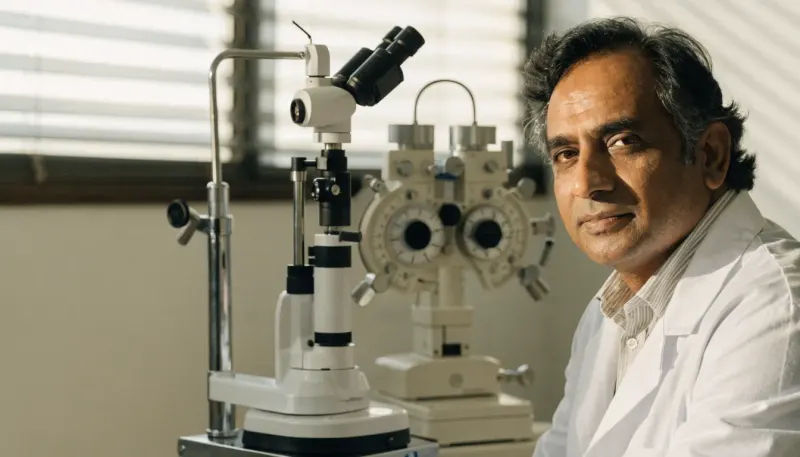

Specialty contact lens fitting is a measured trial-and-review process, not a one-visit product choice. The clinician matches lens design to corneal shape, tear film, prescription, eyelids, visual goals, handling ability, and surface response, then adjusts the lens after real wearing time and follow-up findings.
How Specialty Contact Lens Fitting Works is a common question when regular soft contacts are uncomfortable, unstable, or unable to give clear vision. A specialty fitting is a more detailed visit that looks at the shape of the front of the eye, the health of the cornea, the tear film, the eyelids, and the way a lens moves during real wear.
The goal is not just to find a stronger prescription. The goal is to choose a lens design that can rest safely on the eye, provide useful vision, and fit the reason your eyes need something different from a standard lens.
What matters first for specialty contact lens fitting?
Customized medical lens fitting checks eye shape, tear quality, corneal health, and vision together.
- These fittings may help people with keratoconus, irregular corneas, high prescriptions, dry eye, or prior eye surgery.
- Trial lenses, measurements, and follow-up visits help your eye doctor refine comfort and safety.
- Contact lens wearers should seek prompt care for eye pain, redness, discharge, light sensitivity, or sudden blurry vision.
How Specialty Contact Lens Fitting Works in Real Life
A special-design contact-lens visit starts with the reason standard lenses are not working well enough. Your eye doctor may ask when blur starts, whether lenses shift, how many hours you can wear them, and whether dryness, glare, or ghost images make daily tasks harder.
Then the exam moves from prescription to fit. The doctor may check visual acuity, refraction, corneal curvature, corneal topography or tomography, tear film quality, eyelid position, and the surface of the eye. These details help show whether the problem is mainly optical, dryness-related, inflammation-related, or linked to the shape of the cornea.
The FDA explains that all contact lenses require a valid prescription. That matters because a lens is a medical device that touches living tissue. A specialty lens prescription may include details beyond power, such as diameter, curve, material, edge design, and wearing schedule.
Why a Specialty Lens May Be Recommended
A specialty lens may be considered when glasses or routine contacts do not provide clear or stable vision. It may also be considered when a standard lens irritates the eye or cannot sit in a healthy position.
Common reasons include keratoconus, irregular astigmatism, corneal scarring, dry eye, high nearsightedness or farsightedness, previous corneal surgery, or a need for multifocal correction that standard lenses do not handle well. Some people need a rigid gas permeable lens, some need a hybrid lens, and some need a scleral lens that rests on the white part of the eye instead of the cornea.
A fitting is also a safety check. If the eye surface is inflamed, infected, scratched, or not producing enough tears, your eye doctor may treat the underlying problem before trying to increase lens wear time.
What Happens During the Visit
The visit is usually more detailed than a routine contact lens update. It often includes both measurements and hands-on trial lenses. A trial lens lets the doctor see how the design behaves on your actual eye.
- Corneal shape testing may show steep, flat, or irregular areas.
- Tear film testing may show whether dryness is affecting comfort or clarity.
- A microscope exam may show redness, staining, deposits, lid irritation, or corneal changes.
- Over-refraction checks vision through the trial lens to fine-tune the prescription.
- Lens movement and settling are checked before the final design is ordered or adjusted.
For scleral lenses, the doctor also looks at the fluid space between the lens and the cornea and checks whether the edge presses too much on the white part of the eye. For rigid lenses, the doctor may evaluate movement with blinking and whether the lens centers properly.
Why Follow-Up Visits Matter
A specialty lens often needs refinement after the first fitting. Lenses can settle after they have been worn for a few hours, and comfort at ten minutes may not match comfort at six hours. Follow-up visits allow your eye doctor to adjust the design based on how the lens performs outside the exam room.
Your doctor may ask you to wear the lenses for a set amount of time before returning. This helps show whether there is fogging, redness, pressure marks, dryness, blur, or handling difficulty. Bring your lenses, case, solutions, and any notes about wear time.
It is normal for the process to involve more than one visit. That does not mean the fitting has failed. It means the design is being matched to a complicated surface, and small changes can affect vision, comfort, and eye health.
Safety Signs to Take Seriously
Specialty lenses can be helpful, but safe wear depends on good hygiene and timely care when symptoms change. The CDC advises keeping contact lenses away from water and using fresh disinfecting solution as directed, because water and poor lens care can raise infection risk.
Remove your lenses and seek prompt eye care if you notice warning signs that could point to infection, inflammation, or a corneal problem.
- Eye pain that does not quickly improve after lens removal
- Redness, discharge, or increasing light sensitivity
- Sudden blurry vision, hazy vision, or a new white spot on the cornea
- A lens that suddenly feels tight, stuck, or sharply uncomfortable
- Symptoms after sleeping in lenses or exposing lenses to water
Questions to Ask During the Fitting
The best fitting plan should make sense to you. Ask what lens type is being tried, what problem it is meant to solve, and how success will be measured. Clear expectations make the process less frustrating.
- What eye finding makes this lens design a good option for me?
- How many hours of wear should I build toward, and what symptoms mean I should stop?
- Which cleaning, filling, or storage steps apply to this exact lens?
- How often should the fit and eye surface be checked?
- What backup plan should I use if a lens breaks, gets lost, or becomes uncomfortable?
Individualized lens assessment works best when it combines precise measurements with honest feedback from daily life. If you describe what you see and feel clearly, your eye doctor can adjust the plan in a way that protects both vision and eye health.
Readers leaving How Specialty Contact Lens Fitting Works can continue with When Corneal Topography Results Need Specialist Review, which addresses a distinct step rather than repeating this page.