
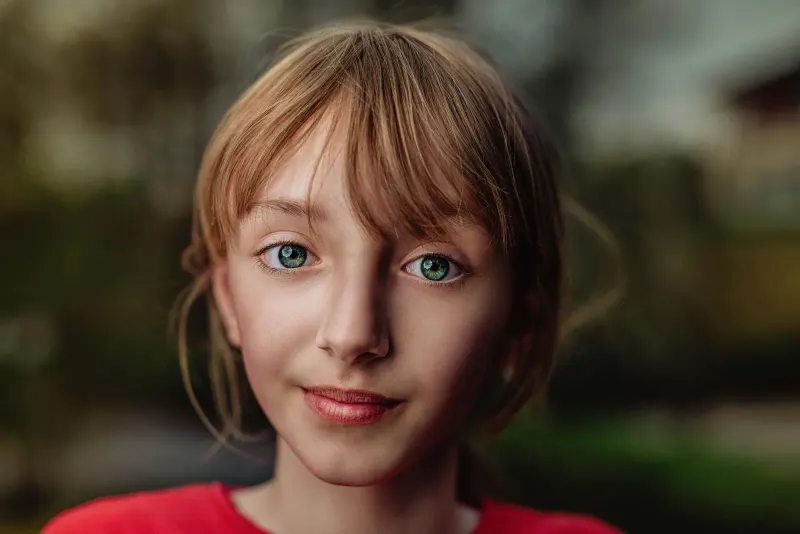
Squinting, sitting close, closing one eye, tilting the head, rubbing, headaches with near work, losing place, school avoidance, or an eye that turns can justify an eye exam. These behaviors do not prove a glasses prescription, and children may have significant vision problems without obvious complaints, so screening and comprehensive exams remain complementary.
A parent checklist for signs a child needs glasses can help you notice patterns, but it cannot diagnose a vision problem by itself. Children often adapt to blurry vision because they may not know what clear sight is supposed to look like. A child may still read, play, or behave normally while one eye is doing most of the work, or while both eyes are straining to keep images clear. For a related symptom pattern, read Unequal Prescriptions in Children and Amblyopia Risk.
What matters first for signs a child needs glasses?
Children may not complain about blurry vision, even when they need glasses.
- Squinting, sitting close to screens, headaches with near work, closing one eye, or trouble seeing the board can be clues.
- Failed vision screening should be followed by a comprehensive eye exam, not watched indefinitely.
- Eye turning, a white pupil reflex, eye pain, sudden vision change, or injury needs prompt medical guidance.
Common Signs a Child May Need Glasses
Some signs are easy to miss because they look like habits. A child who sits close to the television may simply like being near the screen, but the pattern matters. If the same child also holds books close, squints at distance, or avoids reading, vision should be considered.
Watch for these everyday clues:
- Squinting, tilting the head, or turning the face to use one eye more
- Holding books, tablets, or homework very close
- Sitting unusually close to the television or classroom board
- Closing or covering one eye while reading or watching something
- Frequent eye rubbing, especially during near work
- Headaches, tired eyes, or frustration after reading or homework
- Losing place while reading or skipping lines
- A drop in school performance that seems linked with seeing, reading, or copying from the board
One clue alone does not prove that glasses are needed. The goal is to notice repeated patterns and share them during an eye exam. A child may need glasses for nearsightedness, farsightedness, astigmatism, unequal focus between the eyes, or eye teaming concerns. Each of those problems is handled differently.
Why Children May Not Say Vision Is Blurry
Adults often expect a child to report blur, but many children assume everyone sees the way they do. If one eye sees clearly and the other does not, the child may function well enough that parents do not notice. That is one reason vision screening and comprehensive eye exams matter.
Children also have strong focusing ability. Some farsighted children can briefly force their eyes to focus, then become tired, distracted, or uncomfortable during close work. They may be labeled as avoiding reading when the real problem is visual effort.
In younger children, the signs may be behavioral rather than verbal. A toddler may bump into objects, hesitate on steps, dislike picture books, or become upset when one eye is covered. A school-age child may copy assignments incorrectly, complain that words move, or avoid sports that require tracking a ball.
School and Reading Clues
Vision problems can show up at school because the visual demands change through the day. A child may need to switch from looking at a board to looking at paper, track across lines of text, judge spacing, or keep both eyes working together at near range.
Useful questions for teachers or caregivers include:
- Does the child move closer to see the board or classroom screen
- Does the child copy words or numbers incorrectly from far away
- Does reading stamina fade quickly compared with other tasks
- Does one eye drift, close, or water during near work
- Does the child avoid puzzles, books, drawing, or ball play more than expected
These signs can overlap with attention, learning, sleep, and developmental issues, so it is important not to make assumptions. An eye exam helps separate vision-related barriers from other concerns that may also need support.
What Vision Screenings Can and Cannot Do
Vision screenings at school or pediatric visits are helpful, but they are not the same as a full eye exam. A screening is designed to identify children who should be checked more carefully. It may measure distance vision, use photoscreening, or look for obvious alignment concerns.
A child can pass a screening and still have symptoms that deserve an exam. Some problems are intermittent, affect near work more than distance, or involve eye teaming rather than a simple distance chart. On the other hand, a failed screening does not automatically mean glasses will be prescribed. It means the child needs a complete evaluation.
During a comprehensive exam, the eye doctor can check visual clarity, eye alignment, focusing, eye health, and whether each eye is developing appropriately. Dilating drops may be used to relax focusing and measure the prescription more accurately, especially in younger children.
When to Seek Prompt Care for signs a child needs glasses
Most concerns about glasses can be addressed with a scheduled pediatric eye exam. Some signs need faster medical guidance because they may point to an eye health issue rather than a simple prescription change.
Ask for prompt guidance if you notice: The appropriate response depends on its timing, associated symptoms, and the examination findings.
- A new eye turn or sudden double vision
- A white, gray, or unusual reflex in the pupil in photos
- Eye pain, significant redness, light sensitivity, or swelling
- Sudden vision loss, a new droopy eyelid, or unequal pupils
- Vision change after an eye injury or head injury
- A baby or young child who does not seem to fix and follow faces or objects as expected
These symptoms do not always mean something serious is present, but they should not be handled as routine glasses questions.
How Parents Can Prepare for an Eye Exam
Bring any failed screening results, teacher notes, current glasses if the child has them, and a short list of concerns. Include when the pattern started and whether it happens at distance, near, or both. If there is a family history of strong glasses prescriptions, lazy eye, eye turns, or childhood eye disease, mention it.
It can help to describe the child in everyday terms. For example, tell the eye doctor if the child avoids reading after a few minutes, bumps into things on one side, closes one eye in sunlight, or becomes tired after homework. Those details are often more useful than simply saying the child has trouble seeing.
If glasses are prescribed, ask when they should be worn and how follow up will be handled. Some children need glasses mainly for school or near work. Others need them full time to support clear vision and normal visual development. The recommendation depends on the child's age, prescription, eye alignment, and visual development.
References for signs a child needs glasses
American Association for Pediatric Ophthalmology and Strabismus glasses for children. In A Parent Checklist for Signs a Child May Need Glasses, if that is the unresolved part of the decision, Signs a Child May Not Be Seeing Well at School explains the adjacent issue without replacing the examination described here.
- American Association for Pediatric Ophthalmology and Strabismus refractive errors in children
- American Optometric Association children's vision information