
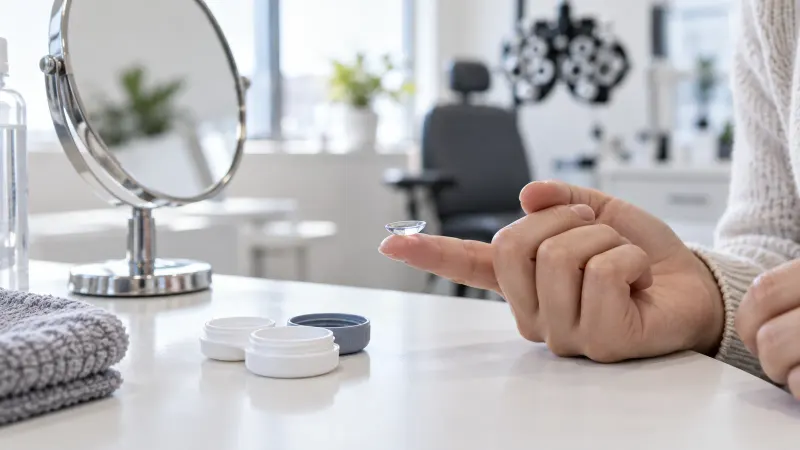
A Practical Plan for Your Toric Lens Visit
What should you do first?
Arrange a contact lens fitting review if your vision shifts after blinking, changes with gaze, or remains inconsistent in a toric lens. Write down when the change happens, which eye is affected, how long the lens has been in, and whether comfort changes too. A contact lens visit can include trial lenses to check their fit and test vision while the lenses are on the eyes. 1 The visit should answer whether the current lens gives repeatable vision and a healthy fit.
When should the fitting discussion wait?
If you have eye pain, unusual redness, light sensitivity, discharge, swelling or blurred vision with contact lenses, the FDA advises removing the lenses immediately, leaving them out and contacting an eye care professional right away. 2 Those symptoms need an eye-health assessment before a routine discussion about rotation. Do not keep wearing the lens just so the clinician can see it move.
Why Toric Lens Orientation Matters
What is astigmatism?
Astigmatism is a common refractive problem that can make vision blurry or distorted because the cornea or the natural lens inside the eye has a different shape than usual. 3 Eyeglasses and contact lenses are common ways to correct it, and a toric contact lens uses an axis that must orient repeatably on the eye. 3 4
What do rotation and orientation mean?
Orientation describes where the toric lens settles on your eye, while rotation describes how far it turns from a reference position. For a toric soft lens to provide repeatable vision, its axis needs to settle in a repeatable position after insertion. Some toric lenses have a scribe mark that the clinician can use to assess orientation and stability. 4 The mark is not something you need to line up by hand.
Does shifting vision prove that the lens rotated?
No. Blurred vision is also listed by the FDA as a possible symptom of contact lens irritation or infection. 2 Your report may lead the clinician to check orientation, prescription, movement, comfort and eye health. Describe the pattern rather than deciding on the cause before the examination.
How to Prepare for the Fitting Review
Make a short vision-and-comfort note
For several ordinary wearing periods, note when blur begins, whether blinking clears it, whether looking up or down changes it, and whether the effect happens in one eye or both. Record comfort separately from clarity. Include any pain, redness, light sensitivity, watering or discharge. Do not repeatedly test yourself throughout the day; a few specific examples are enough to start the discussion. For a related symptom pattern, read Questions for an Eye Visit about Multifocal Contact Lens Adaptation.
Bring the exact lens information
Bring the lens packaging or a clear photo of the label, your current contact lens prescription if available, your glasses and the care products you use. A completed contact lens prescription includes the lens power, material or manufacturer, base curve, diameter when appropriate, issue date and expiration date. 5 Tell the clinician if the lens you wore differs from the prescribed brand or parameters.
Report how you actually wear the lenses
Write down insertion time, average wearing time, replacement schedule, missed replacement dates, overnight wear, water exposure and recent changes in solution or drops. Bring the lens case if you use one. Accurate details help more than an idealized routine. If you have already removed a problem lens, ask the clinic whether to bring it in its case.
Ask whether to arrive wearing the lens
Call the office before the visit and follow its instructions. The clinician may want to see the lens after a normal period of wear, or may want you to leave it out because the eye is irritated. NEI advises removing contact lenses for pain, red eyes, light sensitivity, sudden blur, unusual watering or discharge and calling the eye doctor if symptoms persist or worsen. 1 Safety takes priority over reproducing the blur in the office.
What May Happen During the Visit
The clinician will connect your story to the lens
Expect questions about the task that looks unstable, timing after insertion, blinking, gaze direction, wear time and comfort. The clinician may test each eye's vision with the current lens and compare it with the prescription. NEI notes that contact lens fitting uses trial lenses to assess fit and vision. 1 Bring up a problem that happens late in the day even if the lens looks clear during the appointment.
The lens may be allowed to settle
A newly inserted toric lens can be observed while it settles. In one 39-adult study of a single toric daily disposable design, investigators measured settling time and orientation at set points during the first ten minutes after insertion. 4 That method illustrates why an instant glance after insertion may not answer the whole fitting question. It does not establish one waiting time for every lens.
Orientation marks and blink movement may be checked
The toric study measured a lens mark with a slit-lamp beam and protractor scale, assessed rotational movement with blinking, and evaluated lens movement and centration after the lens had been worn for more than ten minutes. 4 Your clinician may use a different sequence or equipment. You may be asked to blink normally, look in different directions or read while the lens is observed.
The eye itself also needs attention
Contact lens wear can be associated with irritation, corneal abrasions, eye infections and corneal ulcers. 2 A fitting review is a good time to tell the clinician about redness, discomfort or reduced wearing time, even when clarity is the main reason for the appointment. Ask whether the eye surface is healthy enough for continued lens wear.
How to Understand the Findings
What does a repeatable settled position mean?
Published toric fitting research treats settled orientation, movement, centration and blink-related oscillation as separate fit measures. 4 Ask whether the clinician found the resting position predictable and whether vision was clear for your tasks. Ask for the result in ordinary language rather than focusing on one angle alone.
What if the lens rotates inconsistently?
Toric lens stability is important because axis misalignment can reduce visual performance. 4 Ask whether another trial lens, a prescription review or further eye assessment is the appropriate next step. Do not rotate, trim or otherwise modify a soft lens yourself.
What if orientation looks stable but vision is still blurred?
Ask whether the prescription is correct when the lens is settled and whether the clinician found another reason to investigate the blur. Astigmatism itself can cause blurry or distorted vision, and an eye examination is needed to diagnose it and choose the right correction. 3 Ask the clinician to explain the vision, fit and eye-health findings separately.
Write down the outcome in a repeatable format
Before leaving, record the lens name and parameters, the vision measured in each eye, the clinician's description of orientation and movement, and whether the eye-health check changed the plan. Add the new trial instructions, the next appointment and the urgent contact route. A consistent record helps you compare visits without relying on memory. If the clinician uses a number or term you do not understand, ask for a plain-language explanation beside it.
What should a trial plan include?
Leave with the exact lens name and prescription, wearing and replacement instructions, the tasks to test, the next review date and the symptoms that should end the trial early. Use the same short note for the new lens so your comparison is consistent. Report a new problem instead of pushing through the planned trial period.
What This Visit Can and Cannot Tell You
Can the visit identify a workable toric fit?
A contact lens fitting can combine vision testing with observation of how a trial lens fits, while toric assessment can separately consider settled orientation, movement, centration and blink-related oscillation. 1 4 It cannot promise that vision and comfort will be identical in every task or at every hour. A real-world trial and planned recheck may still be needed.
How strong is the toric fitting evidence used here?
The cited fitting study enrolled 39 adult soft-lens wearers and assessed one new toric lens design. The authors stated that only one lens type was investigated and called for further comparison with other marketed toric lenses. 4 The study was funded by the lens manufacturer, and one author was its employee. 4 Its examination methods are useful examples, but its product results should not be used to rank a lens for an individual wearer.
What is the longer-term plan?
NEI recommends that contact lens wearers have an eye examination at least once a year so the eye doctor can check that vision remains clear. 1 Follow the interval your clinician gives you, which may be sooner during a new trial or after a problem. Keep backup glasses available so you can stop lens wear when symptoms occur.
When to Stop Lens Wear or Arrange Care
Remove the lens and call promptly for irritation or infection symptoms
The FDA lists discomfort, discharge, unusual light sensitivity, burning or a gritty feeling, unusual redness, blurred vision, swelling and pain as possible symptoms of contact lens irritation or infection. It advises immediate lens removal, no reinsertion and prompt contact with an eye care professional. 2 Use the clinic's urgent route rather than booking only a routine refit.
Seek urgent assessment when symptoms are severe or worsening
The FDA warns that contact lens problems can include infections and corneal ulcers, may develop quickly and cannot be judged for seriousness from symptoms alone. If pain, light sensitivity, redness or reduced vision is severe or worsening, seek same-day eye care. 2 Use local emergency care if the eye clinic cannot assess a severe problem promptly.
Arrange a fitting review for repeatable shifting blur
If the eye is comfortable and quiet but vision repeatedly shifts after blinking, gaze changes or insertion, arrange a contact lens fitting visit. Bring the exact lens details and your pattern note. Continue only within the wear plan already given by your eye doctor; do not extend wear to make the symptom easier to demonstrate.
Keep routine eye examinations
NEI advises at least yearly eye examinations for contact lens wearers. 1 Keep the scheduled visit even if the lens feels comfortable, and return sooner when the clinician recommends a trial check. Ask which office or after-hours service to contact if an urgent symptom starts.
Common Questions Before a Toric Lens Visit
Should I wear the problem lens to the appointment?
Ask the clinic before the visit. It may want to observe the lens after a normal period of wear, but pain, redness, light sensitivity, discharge, swelling or blur can change that instruction. FDA guidance says to remove a lens immediately and not reinsert it when irritation or infection symptoms occur. 2 Tell the clinic what happened and follow its safety advice.
Should I try to rotate the lens myself?
No. Describe when vision changes and let the clinician observe the settled position. Toric scribe marks can be viewed with a slit lamp during fitting assessment. 4 They are not a request for the wearer to turn the lens on the eye. Bring the package or label so the clinician knows the exact design and prescription. Remove the lens if it becomes painful or unusually red.
Does clearer vision after a blink mean rotation?
It is useful information, but it does not prove the cause. The clinician can compare your report with vision testing, orientation, movement, centration and the eye-surface examination. Blurred vision can also occur with contact lens irritation or infection. 2 Record the pattern and any discomfort, redness, light sensitivity, watering or discharge.
What if only one eye has unstable vision?
Record which eye is affected and test each eye only as the clinic instructs. Bring the details for both lenses because their powers, axes or designs may differ. At the visit, ask for the vision and fit findings for each eye separately. Do not assume the other eye's comfort proves that the blurred eye is healthy.
Should I bring my glasses?
Yes. Glasses give you a backup if the clinician asks you to stop lens wear or changes the trial plan. Bring the current pair even if its prescription is older. If vision is not safe enough for driving after lens removal, arrange another way home. Also bring the lens package, current prescription, case and products you actually use.
Questions About Testing and Results
How long does a toric lens need to settle?
There is no universal settling time in the cited evidence: one product-specific study observed orientation during the first ten minutes and acknowledged that only one toric lens type was tested. 4 Let the clinician decide when the lens has settled enough to interpret. Ask when your result was measured.
Is any amount of lens movement bad?
No single movement number should be interpreted at home. The cited study evaluated movement, centration, blink-related oscillation and orientation as separate measures. 4 Ask whether the lens movement is acceptable for your eye and whether it returns to a consistent position after a blink. The answer also needs to fit your vision, comfort and eye-health findings.
Will I need a different brand?
Possibly, but the visit may point to a prescription change, another lens design, a care issue or an eye-surface concern. The cited study cannot rank brands because it tested one product. Ask what finding supports the proposed change and how the new trial will be judged. Keep both sets of lens details so the comparison is clear.
Can the prescription be changed without another trial?
That depends on what the clinician measures and the lens being prescribed. NEI describes contact lens fitting as placing trial lenses on the eyes to check fit and test vision. 1 Ask whether another on-eye trial is needed, how long to wear it before review and which symptoms should end wear early.
Questions to Ask Your Eye Doctor
- Does this lens settle in a consistent position on each eye?
- What happens to orientation and vision after I blink or change gaze?
- Is the prescription accurate when the lens is settled?
- Does the lens move and center appropriately?
- Is the eye surface healthy enough for continued wear?
- What should I test during the next trial, and when should I return?
- Which symptoms mean remove the lens and call the same day?
Sources
- National Eye Institute (2024). Contact Lenses.
- U.S. Food and Drug Administration (2026). Contact Lens Risks.
- National Eye Institute (2024). Astigmatism.
- Clinical Optometry (2022). Short-Term Fit Assessment of a Novel Daily Disposable, Toric, Silicone Hydrogel Contact Lens.
- U.S. Food and Drug Administration (2026). Contact Lens Prescription.