Getting Ready for Glaucoma Drop Teaching
The short answer
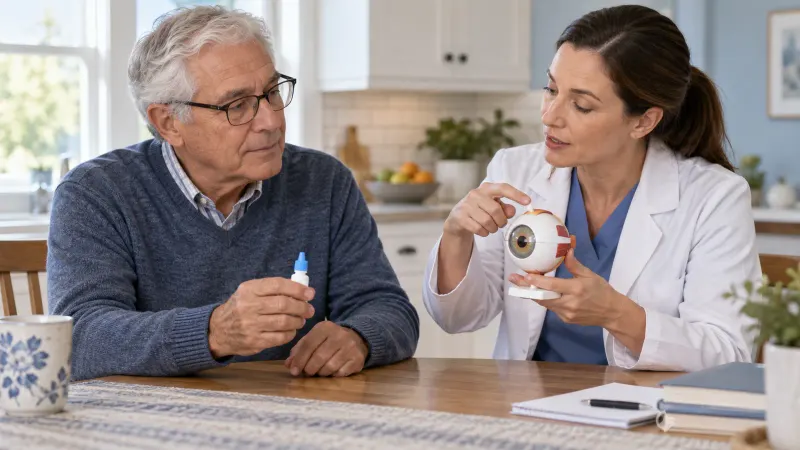
Bring every eye-drop bottle you currently use, your written schedule, and any tool or routine you use at home. Plan to show the clinician how you put in a drop rather than only watching a demonstration. Across observational studies, patients missed the eye, squeezed out multiple drops, or touched the eye or face with the bottle tip. 1 A return demonstration gives the clinician a chance to spot the exact step that is difficult for you.
A simple visit-ready checklist
- Bring the actual bottles, including unopened or single-use containers.
- Write down which eye gets each drop and when.
- Bring your glasses and any magnifier or drop aid you use.
- List all other medicines and health products you take.
- Note whether grip, tremor, neck movement, vision, memory, or bottle stiffness causes trouble.
- Bring a support person if that person may help with drops at home.
The number of daily doses and possible side effects depend on the glaucoma medicine. 2 Bring your own prescription and bottle so the teaching matches your plan.
What this teaching visit can settle
By the end, you should know where the drop should land, how to keep the tip clean, how long to close the eye, and how to separate different eye drops. You should also know whom to call if the bottle is hard to use or the medicine causes a problem. The National Eye Institute advises asking about special tools when putting in drops is difficult. 3
Why Glaucoma Drop Technique Is a Learned Skill
Correct use takes several coordinated steps
A usual technique involves making a pocket with the lower eyelid, placing the prescribed drop into that pocket, keeping the bottle tip away from the eye and eyelid, and then closing the eye. 3 You need enough grip to control the bottle and enough aim to reach the eye without touching it. That combination can feel awkward at first, even when the written instructions look simple.
Difficulty is common and worth mentioning
In one observed clinic study, 46 of 85 people using glaucoma drops had poor technique, and 10 of 85 missed the eye. 4 This was one small clinic sample, so it does not predict your own ability. It does show why a demonstration can be more useful than assuming you are doing something wrong or silently wasting medicine.
Teaching should focus on your barrier
A review identified older age, more severe visual-field loss, and arthritis among factors associated with poorer drop technique. 1 Tell the teacher which step feels unreliable. A useful session tests practical changes one at a time, such as sitting down, supporting your hand on your face, changing the position of your head, or trying a compatible aid.
What to Practice During Glaucoma Drop Teaching
Start with clean hands and a steady position
Wash your hands before using eye drops, and do not touch the bottle tip with your fingers. 3 Choose a position you can repeat at home. Some people sit with their head supported; others lie back. Ask the clinician to watch whether your hand blocks your view or whether the bottle moves when you squeeze it.
Make a lower-lid pocket and aim one drop
Looking up while gently pulling the lower lid down creates a pocket for the drop. 3 Hold the tip just above that pocket and use the number of drops on your prescription. Avoid touching the eye, eyelid, or lashes with the tip because contact can contaminate the bottle. 3 If you cannot tell whether the drop landed, ask for a way to check without automatically adding another drop.
Close the eye and press near the tear duct
After the drop goes in, close the eye and press lightly at the inner corner over the tear duct for at least one minute. 3 Ask the clinician to show the location and pressure. Keep the eyelids gently closed rather than squeezing them shut. 1 Keep a clean tissue ready for liquid that runs onto the cheek, without wiping the bottle tip.
Separate different eye drops
If you use more than one type of eye drop, wait at least five minutes between different types. 3 Bring your full schedule so the clinician can help you place that interval into your day. Ask which bottle comes first if your own instructions specify an order, and record the answer rather than relying on memory.
Finish with a return demonstration
Previous instruction was associated with better technique in an observed study, and the authors recommended watching patients perform the steps. 4 Use a practice bottle if the clinic provides one. Ask the observer to name one thing you did well and the first step to change. Repeat until you can perform the agreed method in the position you will use at home.
What to Tell the Clinician Before You Practice
Bring your health and medicine list
Glaucoma drops can interact with other medicines, so the National Eye Institute advises telling your doctor about everything you take. 2 Also mention breathing problems, heartbeat concerns, allergies, pregnancy, recent eye surgery, or a new eye infection. The relevant precautions depend on the exact product, so use the label and your prescriber's instructions for your bottle.
Describe physical and visual barriers
Tell the clinician if you cannot tilt your head comfortably, see the bottle tip, squeeze the container, or keep your hand steady. Across the studies in one review, older age, more severe visual-field loss, and arthritis were among the factors associated with poorer technique. 1 This information helps the teacher adapt the method or consider a compatible device instead of asking you to repeat an unsuitable movement.
Do not share or improvise with bottles
Bring only bottles prescribed for you, and keep each cap with its bottle. The bottle tip should stay away from fingers, the eye, and the eyelid to reduce contamination. 3 If a cap is lost, the tip touched another surface, or the bottle looks damaged, ask the pharmacist or eye-care team how to replace it.
Side Effects to Discuss During Teaching
Expected effects depend on the medicine
Glaucoma medicines can cause stinging, itching, burning, redness, blurred vision, headache, dry mouth, or changes around the eye, but the pattern depends on the specific medicine. 2 Ask which effects are common with your bottle, how long a brief sensation should last, and which change means you should call. Do not use someone else's experience as a substitute for your own product information.
Whole-body symptoms also matter
Some glaucoma drops can be associated with changes in energy, heartbeat, or breathing. 2 Tell the clinician about new symptoms and when they occur in relation to the drop. If breathing becomes difficult or you feel severely unwell, seek urgent medical help.
Technique questions can uncover a practical cause
If medicine runs onto your cheek, the tip repeatedly touches your eyelid, or you squeeze out several drops, show that during the visit. Studies reviewed in the glaucoma literature commonly found extra drops, missed eyes, and bottle-tip contact. 1 Ask the clinician to correct the movement and to review any persistent symptom separately.
Making the Technique Work at Home
Use a written plan that matches the prescription
Create a simple chart with the bottle name or color, the eye, and the time. Check the label each time rather than relying only on cap color. Glaucoma drops may need to be used every day, and the number of daily doses depends on the medicine. 2 Ask what to do if you are uncertain about a dose, travel across time zones, or run out early.
Ask about aids before buying one
In a review, several mechanical-aid studies reported improvement in at least one technique measure, and some aids were designed for a particular bottle. 1 Bring your bottle when discussing an aid. The teacher can check whether it fits, whether you can load it safely, and whether it actually improves aim without touching the eye.
Plan for help if self-use stays unreliable
If repeat teaching does not solve the problem, discuss who could help and when. A family member or caregiver should receive the same clean-hand, clean-tip, spacing, and tear-duct instructions. Keep the plan realistic for every scheduled dose. Difficulty using a bottle is a recognized reason to ask the eye doctor about a special tool. 3
When to Contact Your Eye-Care Team
Call promptly for a new or worsening problem
Contact the prescribing eye-care team if you repeatedly miss the eye, cannot squeeze the bottle, run out earlier than expected, or are unsure which bottle goes in which eye. Tell your doctor about side effects because the appropriate response depends on the specific medicine. 2 A technique visit can be arranged before the next routine check when a barrier keeps you from following the written plan.
Get urgent help for severe symptoms
Changes in breathing, heartbeat, or energy are possible side effects of some glaucoma medicines. 2 Follow the urgent instructions on your own medicine label and contact a medical professional if these occur. Sudden intense eye pain with blurred vision, a red eye, or nausea needs immediate eye care because it can be a sign of acute angle-closure glaucoma. 5 These symptoms do not prove the drop caused the problem, but they should not wait for an online technique lesson.
Keep routine glaucoma follow-up
Glaucoma drops lower eye pressure and help prevent further optic-nerve damage, but they do not restore vision already lost. 2 Technique is one part of care. Keep the eye-pressure and optic-nerve follow-up your clinician recommends, and bring your bottles again if the schedule changes or the method becomes difficult.
Common Questions Before a Drop-Technique Lesson
Should I bring my real bottles?
Yes. Bring every glaucoma drop you currently use because bottle shape, stiffness, cap, and schedule affect the lesson. The teacher can check how you identify each medicine and whether an aid fits. Keep the bottles in their labeled packaging when possible. Also bring a list of other eye drops, prescription medicines, and other health products so the clinician sees the full routine.
What if I feel embarrassed about my technique?
Say that you want the clinician to watch from the beginning. In one clinic study, 46 of 85 people had poor technique, and most people with poor technique were unaware of the problem. 4 The point of observation is to find a movement that works for you. Ask for one correction at a time, practice it, and repeat the demonstration before leaving.
Can I practice with artificial tears?
Ask the clinic. A practice bottle may let you demonstrate the movement without using an extra dose of prescription medicine. In the observed study cited here, participants demonstrated with artificial tears. 4 Use the bottle the clinic provides or approves, and do not replace your prescribed medicine with artificial tears.
Do I need a mirror?
It depends on what helps you aim without touching the tip. Ask the clinician whether you should try a mirror, lie back, or support your hand against your face. Have the clinician watch the options you can repeat at home and choose one that puts the drop in the lower-lid pocket while keeping the bottle tip clean.
How do I know the drop went in?
Ask the clinician what cue is reliable for you. During the lesson, have the observer confirm whether the drop reached the eye and whether the tip stayed clear. Before you leave, ask for a specific plan for a missed or uncertain attempt.
More Questions About Using Glaucoma Drops
Why press the inner corner of my eye?
Light pressure over the tear duct at the inner corner of the eye helps keep the drop from draining into the nose, and the National Eye Institute advises holding that pressure with the eye closed for at least one minute. 3 Ask the teacher to show the exact spot and check that your pressure is gentle.
How long should I wait between different drops?
Wait at least five minutes between different types of eye drop. 3 If your prescription or clinician gives a different sequence, follow that individualized instruction. Write the timing into your schedule during the lesson. If fitting the interval into your day is difficult, ask the pharmacist or prescribing team to help you plan it.
What if I cannot squeeze the bottle?
Bring the bottle and demonstrate the problem. Special tools may help some people who have trouble using eye drops, although a device may fit only certain bottle designs. 3 1 Ask the clinician or pharmacist to confirm compatibility and teach you how to load and clean the aid.
Can a family member learn with me?
Yes, especially if that person may help with drops at home. Ask them to attend the teaching and perform a return demonstration. Both of you should know the bottle, eye, time, clean-hand steps, and whom to call when something goes wrong. Keep a written schedule where the person giving the drop can check it.
Questions to Ask Your Doctor
- Can you watch me use my own bottle and correct the first difficult step?
- Which eye gets each drop, and what is the exact schedule?
- Which side effects are expected with my medicine, and which require a call?
- Would a bottle aid or caregiver help be appropriate for me?
- What should I do if I miss the eye, touch the tip, or run out early?
Sources
- Current Opinion in Ophthalmology (2019). Drop instillation and glaucoma.
- National Eye Institute (2024). Glaucoma Medicines.
- National Eye Institute (2024). How to Put in Eye Drops.
- Eye (2013). Eye drop instillation technique in patients with glaucoma.
- MedlinePlus, U.S. National Library of Medicine (2024). Glaucoma.