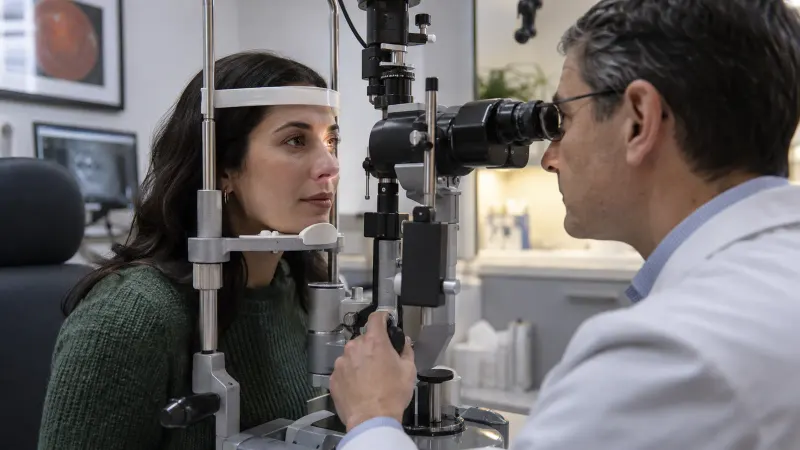

Your return-to-activity plan at a glance
Base each decision on your graft and your latest examination
Start by asking what part of the cornea was replaced, whether a bubble or stitches are in place, and what the surgeon saw at follow-up. Use this guide to organize the questions and milestones that matter. Follow your own discharge instructions.
A corneal transplant can replace the full thickness of the cornea or only selected layers, and recovery time differs by procedure. 1 Ask the team to write down the exact procedure name. Examples named in NHS hospital guidance include penetrating keratoplasty (PKP), Descemet stripping endothelial keratoplasty (DSEK), and Descemet membrane endothelial keratoplasty (DMEK). 2
For each activity, ask three questions: Is your vision adequate for the task? Could the activity expose the eye to impact, pressure, water, dust, or strain? Has the transplant team cleared it at the relevant visit? For a related symptom pattern, read Preparing Your Home and Schedule for Corneal Transplant.
Protect the graft while becoming active again
After surgery, patients are generally told to use prescribed drops, avoid rubbing or pressing on the eye, and use an eye shield or glasses for protection as directed. 1 Keep drops, protective eyewear, and the transplant team’s daytime and after-hours numbers together. Tell the eye doctor right away about new eye pain or worsening vision after a corneal transplant. 1
Create a one-page activity record for the first few weeks. List the task, duration, symptoms before and after, and any question to raise at the next appointment. This can help you describe a change precisely without trying to remember several days at once. Keep the record simple enough that you will actually use it. It is a communication aid, not a test you have to pass. You can compare this topic with Follow-up Monitoring for Salzmann Nodular Degeneration.
Put drop times, positioning instructions, appointment transport and questions for the team into one daily schedule. Record any symptom change and use the contact instructions provided by the transplant service.
Why the type of transplant changes recovery
Full-thickness and anterior-layer grafts
Penetrating keratoplasty replaces the full thickness of the cornea, while a partial-thickness transplant replaces only part of the cornea. 1 Ask how stitches and the expected visual recovery affect your own activity plan.
Endothelial grafts and the supporting bubble
When just the inner layer of the cornea is replaced, an air bubble may be used to hold the new tissue in place. 3 Some patients are asked to lie on their back during the first days so the bubble supports the graft. 3 Follow the position and schedule prescribed by your own team.
Who needs a more cautious activity plan
People with a bubble, stitches, or slow visual recovery
Royal Free London says an air or gas bubble can blur vision for one to two weeks and advises avoiding high or low altitude until the bubble has disappeared. 4 If your surgeon says a bubble remains, ask specifically about air travel, mountain travel, driving, and positioning. If you have stitches, ask whether work or sport could expose the eye to impact.
People whose work carries extra risk
Leeds advises two to three weeks away from work and says heavy manual work, lifting or work in an unclean environment may require three to four months away. 2 Describe lifting, bending, dust, chemicals, machinery, night driving, screen demands and access to drops when asking about work.
Set up the plan before you leave and at early follow-up
Leave with six answers in writing
Confirm: your procedure name; drop names and times; shield schedule; permitted sleeping or head position; first follow-up date; and the number to call if symptoms change. The National Eye Institute describes corneal transplant as outpatient surgery, says patients need a ride home, and schedules a follow-up appointment the next day. 1 One NHS transplant service also advises that an adult remain with the patient for the first 24 hours. 4
Turn restrictions into examination-based milestones
Ask the clinician to complete sentences such as “You can drive when…,” “You can lift your usual load when…,” and “You can swim when….” Royal Free London schedules a follow-up two to three days after surgery to check that the transplant has not moved. 4
What the eye is doing during recovery
The new tissue must remain protected
Rubbing or pressing the operated eye is specifically discouraged after corneal transplant surgery. 1 Ask how long the protection instructions apply to your eye.
Vision may lag behind physical comfort
Published patient guidance gives different visual recovery ranges by operation: up to about six months after an inner-layer graft, 18 months after an outer- or middle-layer graft, and two years after a whole-cornea graft. 3 Ask what improvement your surgeon expects by the next visit.
Activities to delay until the team clears them
Avoid pressure, contamination, and impact
National NHS guidance advises avoiding swimming and eye makeup for at least a month and avoiding contact sports until the specialist says they are safe. 3 The National Eye Institute advises wearing eyeglasses or a special shield for protection as directed after surgery. 1
Do not improvise around a bubble or medication plan
Royal Free London says some patients may be advised to lie flat, looking toward the ceiling, for four to seven days to help prevent transplant dislocation. 4 Do not stop steroid or pressure-lowering drops unless the corneal team directly tells you to do so; premature stopping can contribute to graft failure and vision loss. 5 Contact the prescribing team if you cannot follow the schedule or obtain a refill.
A practical return to daily activities
The first 24 to 48 hours
Arrange the ride home and any help requested by your surgical team. Royal Free London says an air or gas bubble can blur vision significantly for one to two weeks and advises wearing the eye shield at night for the first week. 4 Follow the positioning and pillow instructions given by the surgical team.
The first weeks: reading, screens, chores, and personal care
Reading, television, light housework, and shopping are examples of light activities allowed by one NHS corneal graft service. 2 Royal Free London advises avoiding soap in the eye for two weeks, gardening for four weeks, and rubbing the operated eye. 4 Follow the restrictions in your own discharge plan.
Work, study, and driving
National NHS guidance says patients may need around two weeks away from work, while Royal Free London says manual or driving work may require longer. 3 4 Ask whether shorter hours, drop breaks or temporary task changes are appropriate. Driving should wait until the clinician confirms it is safe and the driver meets the applicable legal vision standard. 3
Exercise, lifting, swimming, and travel
For exercise, ask for a lifting limit in kilograms and a review date. Local transplant instructions vary: one service advises no lifting over seven kilograms or strenuous exercise for two weeks, while another advises avoiding heavy lifting and strenuous exercise for six to eight weeks. 4 2 NHS guidance advises avoiding swimming for at least four weeks, and Royal Free London advises avoiding high or low altitude until an air or gas bubble has disappeared. 3 4
Progress, setbacks, and long-term protection
Judge progress over visits, not hours
Track drop use, activities, symptoms and questions to discuss at follow-up. Follow-up appointments may begin within the first week and then occur every few months for one to two years or sometimes longer. 3 Keep the appointments scheduled by your transplant team.
Know that rejection can occur later
Graft rejection can occur from days to years after surgery, but prompt treatment is often effective. 5 Pain, light sensitivity, redness, and cloudy, hazy, or blurred vision are recognized warning signs. 1 Keep the transplant history and clinic number available even after regular life has resumed.
Expect an individual visual outcome
Potential complications listed by the National Eye Institute include infection, bleeding, glaucoma, and retinal detachment. 1 Ask what the next visit is intended to assess and what change should prompt an earlier call.
When to contact the transplant team
Get urgent eye advice for a new warning symptom
Contact your transplant or emergency eye service urgently for new or increasing redness, eye pain, light sensitivity, or worsening or cloudy vision because these can signal graft rejection. 1 Also seek urgent assessment for severe pain, discharge, an eye injury, sudden new floaters or flashes, or a curtain-like shadow in the vision. 2 3
Call for routine-plan problems too
Cambridge University Hospitals advises contacting the corneal service if a follow-up appointment is delayed. 5 Call as well if instructions conflict, you cannot maintain the prescribed position, or work duties make the restrictions impossible.
Frequently asked questions about everyday activities
When can I use a phone, computer, or television?
Reading and television are permitted as light activities in postoperative guidance from an NHS corneal graft service. 2 Ask whether prescribed positioning limits how you should use a phone or screen.
When can I return to work?
When can I drive?
Can I bend, lift, or do housework?
Leeds permits light housework and shopping while advising patients to avoid heavy lifting for six to eight weeks. 2 Published hospital instructions range from a two-week restriction on lifting more than seven kilograms to six to eight weeks without heavy lifting. 4 2 Use the limit written by your surgeon.
When can I shower or wash my hair?
Royal Free London advises avoiding soap in the operated eye for two weeks. 4 Ask the transplant team how and when to shower or wash your hair.
More questions to plan your recovery
When can I swim?
NHS guidance advises avoiding swimming for at least four weeks after corneal transplant. 3 Ask for an individual clearance date rather than assuming four weeks is automatic permission.
Can I fly after surgery?
One NHS transplant service advises avoiding high or low altitude until an air or gas bubble has disappeared. 4 Ask the surgeon to confirm whether a bubble remains and when your planned route is safe.
How long will I need drops?
Steroid drops may continue for a year or, in some patients, for life, and Cambridge University Hospitals advises not stopping them without clear instructions from the corneal team. 5 Arrange refills before the bottle runs out.
What if the bandage contact lens falls out?
If a bandage contact lens used after surgery falls out, Royal Free London instructs patients not to put it back themselves. 4 Ask the clinic in advance whom to contact if this happens.
Questions to ask your doctor
- Which transplant did I have, and do I still have a bubble or stitches?
- What position should I use, for how long, and what should I do if I cannot maintain it?
- Which activities can I start now, and which require examination-based clearance?
- What lifting limit applies to me, and when will it be reviewed?
- What vision milestone must I meet before driving or returning to safety-sensitive work?
- How long should I use each drop, and whom should I call for refills or missed doses?
- Which symptoms should prompt a same-day call, and where should I go after hours?
Sources
- National Eye Institute (2025). Corneal Transplants.
- Leeds Teaching Hospitals NHS Trust (2026). Corneal Graft Post Operative Advice.
- NHS (2025). Cornea transplant.
- Royal Free London NHS Foundation Trust (2024). Having a corneal transplant.
- Cambridge University Hospitals NHS Foundation Trust (2025). Corneal transplantation.