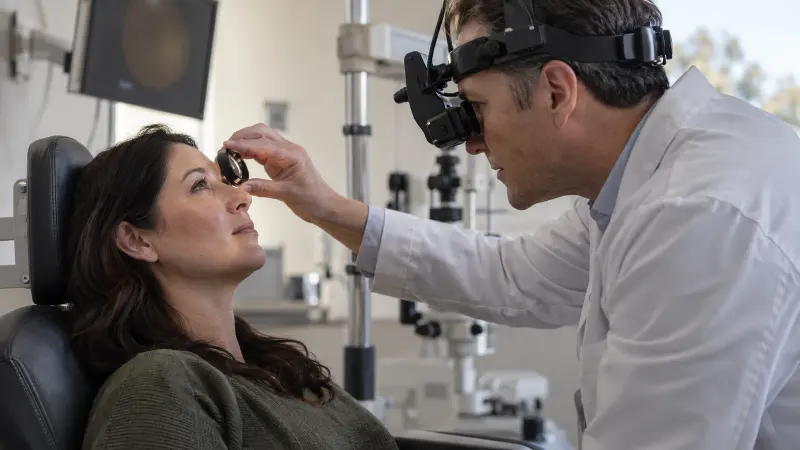

Understand the central vision connection.
Geographic atrophy can affect the detail in front of you.
Geographic atrophy can enlarge and affect central sight. It is a late form of dry age-related macular degeneration (damage to the central retina), also called dry AMD. Central sight helps with detail near the point you look toward. A change may show up during reading, seeing a face, preparing food, or viewing a sign.
The effect differs with the location and pattern of change in each eye. A symptom cannot show how much geographic atrophy has changed or rule out another cause. Report new or worsening sight concerns to your eye care team and let an exam guide the explanation.
Think of central vision as a task zone.
Central sight is not a separate picture in the middle of sight. It works with the rest of sight as you scan a page, find an object, or move through a room. Trouble with one detail task may be the first clue. At that point, saying “my sight is worse” may not feel accurate.
Use tasks to describe the concern rather than trying to map the retina at home. The retina is the light-sensing tissue at the back of the eye. Geographic atrophy involves areas of that tissue. But an eye care professional needs retinal findings to interpret what your experience means.
Expect the two eyes to contribute in different ways.
One eye may handle a task in a different way from the other. Using both eyes can hide some difficulty. That does not mean a home eye-cover check can measure disease. It gives you a way to describe which eye seems to struggle during a familiar activity.
If you compare eyes, use one brief check without straining or repeating it. Record the task and what differed, then return to using sight in your normal way. Bring the observation to the doctor instead of treating it as a test result.
Know when to seek care for a sudden change.
Do not attribute sudden new distortion or sight loss to geographic atrophy on your own. Contact an eye care professional about a sudden or marked change. Ask what level of care it needs. A known diagnosis does not explain every new symptom.
State what changed and when you noticed it. Say whether one eye or both eyes seem involved. Mention any new distortion, dark or missing area, or drop in function in your own words. The care team can decide how soon and where to check it.
Notice function without turning it into a home test.
Watch reading in more than one format.
Reading trouble can take many forms. You may lose your place, miss parts of words, need more light, or tire before you finish. Note whether the issue appears with print, a screen, labels, or handwriting. Use the material you already read instead of a test chart.
Write down what adjustment helped, such as larger text, stronger contrast, or a reading guide. The response shows what supports function; it does not measure retinal change. Tell the doctor when the adjustment stopped helping or when the task became unsafe.
Record face and object recognition problems.
Central detail helps you see facial features. It also helps you find a small item against a similar background. Describe the setting where the problem appears. Distance, light, contrast, and motion can change the task even when the object stays the same.
Avoid turning an error into a conclusion about lasting damage. Instead, state what you expected to see and what you missed. A concrete example can help the eye care team connect your concern with exam findings and support needs.
Note blank, dim, or distorted areas in plain words.
Some people use words such as blank, dim, smudged, bent, or missing. These words may describe central sight trouble. Use the word that matches your experience without forcing it into medical language. State whether the area stays in the same place from your point of view. Note if it appears during a certain task.
A self-drawn sketch may help communicate position. But it cannot diagnose geographic atrophy or measure its growth. Date the sketch and label the eye you meant. Report a sudden new area or new distortion rather than waiting for a planned visit without advice.
Separate speed from accuracy.
A task can become slower before you notice more mistakes. Mistakes can also rise while speed feels unchanged. Track these two parts apart. For example, you may still read a bill but need more passes. Or you may misread a number despite taking your usual time.
This split gives the doctor and sight-support team a more useful picture of function. It can also help you ask for the right accommodation. Do not set a pass mark that you must meet before seeking support.
Build a central vision task mosaic.
Choose four tiles that matter in your life.
Create a page with four task tiles that reflect your needs:
- words for reading, forms, messages, or labels.
- faces for conversation and social connection.
- objects for cooking, medicine labels, hobbies, or money.
- movement for signs, steps, travel, or driving decisions.
Pick one ordinary example inside each tile and write what has changed. The mosaic shows where central detail affects your day-to-day life without reducing your life to one sight score. Change the examples when your needs or common tasks change over time.
Add context beside each tile.
Beside each example, note the eye or eyes and the light setting. Add the contrast, distance, and aid you used. Record the direction of change, such as better, stable, worse, or new. Keep entries short enough to review during a visit.
Context prevents two unlike situations from looking the same. Reading pale print in dim light creates a different task than reading dark print under good light. The record helps the doctor understand the demand without claiming that the setting caused the retinal finding.
Mark the safety and independence effect.
For each tile, state whether the change is a bother or requires help. Also mark any safety concern. If driving, cooking, stairs, or medicine checks no longer feel safe, pause that task and arrange support. Tell the eye care team what made you stop.
This marker guides the talk toward immediate function as well as retinal monitoring. It does not predict how sight will change. Ask about rehab or accessibility support when a task barrier limits independence.
Bring the mosaic to every relevant clinician.
Share the same page with the retina doctor, general eye care professional, and sight-support provider when those people take part in your care. The common tool can reduce gaps between the medical findings and the tasks you want to protect.
Update the mosaic when a clear change occurs, not after every attempt at a task. Keep earlier pages so you can describe the sequence. Let the clinical team decide how that history fits the eye findings.
Prepare for monitoring and treatment conversations.
Ask what the retinal findings mean for function.
Ask where the geographic atrophy sits. Ask how the doctor thinks that spot relates to your current task problems. Request a plain explanation of what the images show. Retinal imaging creates pictures of the back of the eye. The doctor must read those pictures with the exam and your experience.
Also ask what remains uncertain. The size or location of an area cannot promise a specific sight outcome for one person. Your task mosaic gives the discussion a functional anchor without replacing retinal review.
Keep supplement research separate from a personal plan.
Research about supplements does not create personal advice. Ask your doctor whether it applies to your diagnosis, eye findings, health history, and current medicines. Do not start, stop, or change a supplement based on a general article.
Bring the names and amounts of products you already take. Ask who should review possible interactions or risks. A research result and a personal care decision answer different questions, so keep the bridge between them doctor-led.
Discuss approved treatment without assuming candidacy.
An approved treatment exists for geographic atrophy from AMD, but it does not fit every person. A retina doctor needs to examine the eyes. You can then discuss possible benefits, burdens, risks, and follow-up in your case.
Ask what goal the option has and how the team would judge its value for you. Avoid seeking a promised sight result or a fixed injection schedule from general guidance. The decision belongs in a benefit-risk talk based on your retinal findings.
Leave with a reporting and support plan.
Ask which changes the team wants you to report before the next planned review. Confirm the contact route for a sudden or marked change. Write down the purpose of follow-up and how your mosaic should inform the next visit.
Add a support step for any task that already causes risk or dependence. That may mean an accessibility review, a reading adaptation, transport help, or another doctor-led resource. A monitoring plan should address what you need to do between eye visits, not just what the images show.
Questions about geographic atrophy and central vision.
Does geographic atrophy affect all vision at once?
Geographic atrophy can affect central sight, but the functional effect differs with the location and pattern in each eye. One task may become hard while another remains manageable. Your eye care team can connect retinal findings with the changes you report.
Can I diagnose geographic atrophy from a blank spot?
No. A blank, dim, distorted, or missing area cannot establish the diagnosis or find its cause. Describe the experience and arrange an eye review. Report a sudden new distortion or loss rather than assuming it comes from known atrophy.
What should I track between retina visits?
Track clear changes in reading, face recognition, object finding, movement tasks, and safety. Add the eye involved, start, light setting, and direction of change. Avoid repeated home testing, and use the reporting instructions from your retina team.
Do supplements treat geographic atrophy?
General research about supplements does not show whether a product fits your health needs. Ask your doctor to review your eye findings, medicines, and risks before you make a change. Do not treat a research headline as a personal prescription.
Does an approved treatment fit every person?
No. Approval does not make every person with geographic atrophy a candidate. A retina doctor must check the eye and discuss potential benefit, risk, burden, and follow-up. General guidance cannot select the option or predict your sight result.
How can I explain the vision change at my visit?
Bring a central sight task mosaic with four examples from your life. State what became harder, the setting, and the eye involved. Note whether the change affects safety or independence. This gives the doctor clear details without asking you to diagnose yourself.
Arrange a central vision review.
Contact your eye care team about new or worsening central sight concerns. Report sudden new distortion or loss without blaming it on geographic atrophy. Bring your task mosaic so the visit links eye findings with the reading, recognition, and movement needs that matter to you.