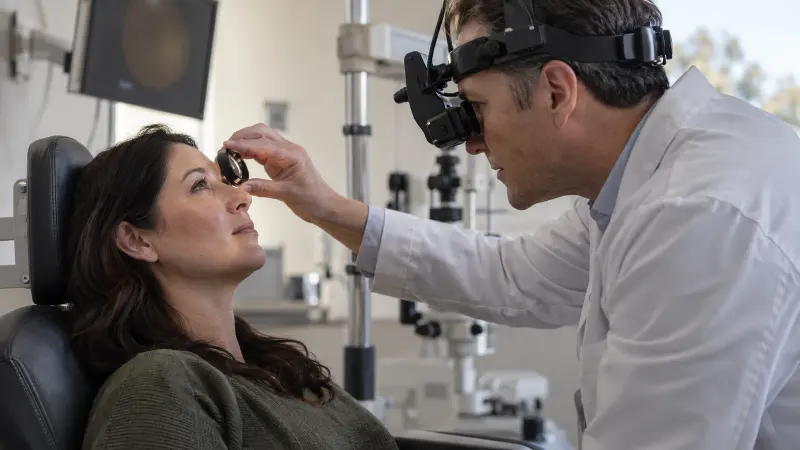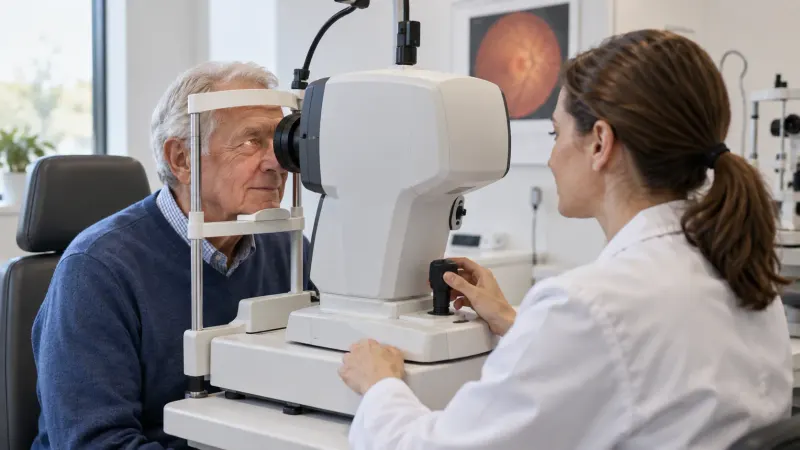

Connect night vision with the retinal diagnosis.
Retinitis pigmentosa can affect sight in low light.
Retinitis pigmentosa can affect night sight and peripheral sight. Peripheral sight is the part of sight outside the center of what you look toward. If you have this retinal diagnosis, tell your eye care team about new or worsening trouble in dim settings and explain which tasks have changed. For a related symptom pattern, read What Happens During Retinal Tear Diagnosis.
Poor night sight by itself cannot confirm retinitis pigmentosa. An eye care review must establish the diagnosis and interpret any change. If you do not have a diagnosis, describe the concern without naming its cause and arrange an eye review.
Use function to describe the change.
“I cannot see at night” may hide several different problems. You may struggle to find an object in a dim room or notice a person approaching from the side. You may also have trouble crossing an uneven space or adjusting after a light change. Name the action that became hard and the setting where it occurred.
Add the place, light transition, and support you used. These details help the doctor understand your sight function without asking you to grade your retina at home. They also guide a useful talk about support for the tasks you value.
Separate a known pattern from a new event.
A familiar low-light difficulty and a sudden new sight change need different conversations. Follow the monitoring plan for the known pattern. Report a clear change in function to the doctor managing the retinal condition. New sudden sight changes require clinical review rather than a routine adjustment to a support tool.
State whether the event began at once, which eye or eyes seem involved, and what changed from your prior level. Do not assume retinitis pigmentosa explains every new symptom. Ask the care team how soon and where they want to check it.
Keep prognosis claims out of the symptom record.
A hard evening does not predict a fixed course for your sight. Retinitis pigmentosa can affect people in different ways, and general guidance cannot forecast your rate or outcome. Record the task barrier without turning it into a conclusion about what will happen next.
Bring questions about expected change to the eye care team that knows your findings. Ask what the exam can show and where uncertainty remains. Avoid unproven treatments or claims that promise to reverse lost retinal function.
Map the parts of a low-light task.
Start with the light transition.
Write down where you came from and where you went, such as a bright store into a dim parking area. Note whether the problem began during the transition or remained after you had time in the new setting. Do not turn the exercise into a timed sight test.
The goal is to show the setting that exposes difficulty. If the transition creates a fall, collision, or travel risk, pause and ask for assistance. Tell the doctor what support allowed you to complete the route.
Record the field demand.
Peripheral sight can matter when you scan for people, obstacles, doorways, and moving objects. Note whether you missed something at the side, had to turn your head more, or felt unsure where an object sat. Use one concrete example instead of a broad claim about your sight field.
Do not perform a home field test to decide whether disease has changed. A sight field test is a clinical measurement of how much you can see around a fixed point. Your observation describes function, while the doctor’s review measures and interprets the eye.
Describe contrast and clutter.
A dark object against a dark background may create a different demand from a bright object on a plain surface. Crowded spaces can also make scanning harder. Note the contrast, clutter, and movement in the scene without assuming they caused the retinal problem.
This context can reveal why two places with similar light feel unlike each other. It can also help a rehab provider suggest task-specific changes. Keep the record focused on what you could find, avoid, or complete.
Include the recovery after the task.
Write whether you needed help to finish, stopped the activity, or changed the route. Add any fall, near miss, or bump that occurred. These outcomes show the practical effect and may change which support need comes first.
Do not repeat a hazardous route to see whether the problem happens again. One event can support a useful discussion. If the change came on at once or differs in a major way from your known pattern, contact the eye care team for clinical guidance.
Build a low-light route card.
Choose one route that matters.
Select a route you need, such as moving from the bedroom to the bathroom, leaving work after sunset, or entering a building from outdoors. Write the start and destination at the top of a card. Choose a route with personal value rather than a route designed as a test.
If the route feels unsafe, do not practice it alone. Ask another person to walk with you or choose a safer option while you seek support. The card helps plan access; it does not certify safe travel.
Divide the route into four checkpoints.
Use these four route checkpoints to organize the card before discussing it with a professional:
- entry showing the first change in light.
- scan showing where side vision helps locate people or objects.
- obstacle showing steps, curbs, furniture, or moving hazards.
- exit showing how you complete or leave the route.
At each point, record the barrier and the support that helped. The structure turns a vague night-sight complaint into a sequence that an eye care or rehab professional can review. Avoid rating the route with a medical score.
Add confidence and safety notes.
Beside each checkpoint, state whether you felt comfortable, needed help, or stopped. Mark any task that involves driving, traffic, stairs, or heat. These notes make risk visible without claiming that confidence measures sight.
Tell the doctor if your confidence fell because the sight experience changed, not just because the place was unfamiliar. If driving no longer feels safe, stop driving and arrange transport. Ask the eye care team how to approach the concern.
Compare support rather than disease.
After a professional recommends a support change, record whether it helped you complete the route with less strain or more confidence. Do not use success to conclude that the retinal condition improved. Rehabilitation supports use of remaining sight. It does not restore retinal function or replace monitoring.
Bring the card back when a support fails or the task changes. The provider can adjust the approach around your goals, present sight function, and a new route barrier that needs attention. Keep clinical monitoring with the retinal team that knows your diagnosis and findings.
Turn observations into a care plan.
Bring the route card to the retinal visit.
Show the doctor where the low-light task breaks down and what changed from your known level. Add the start, eye involved if known, and any sudden feature. Ask how the report fits the exam without expecting the card to prove progression.
Request a plain explanation of night sight and peripheral sight findings. Ask which changes the team wants you to report before the next planned review. Write down the contact route for a sudden new event.
Ask for vision rehabilitation when function shrinks.
Vision rehab can support use of remaining sight and independence with tasks. Services and tools should reflect your sight function and goals. Ask whether a review could address night movement, home access, work, reading, or travel.
Rehabilitation does not replace retinal monitoring and does not restore lost retinal function. Treat it as a practical support pathway that works beside medical care. Bring the low-light route card so the review starts with a task you need.
Plan alternatives before a risky outing.
For a place that creates risk, choose a transport option, companion, route, or time that reduces the low-light demand. Keep a working light source available if a rehab professional recommends it for the task. Do not wait for a near miss before asking for help.
Tell the care team what change forced the alternative. A safe workaround does not erase the need to report new or worsening function. It protects participation while your team reviews the concern.
Create a shared response sentence.
Write one sentence that you and a support person can use: “My known low-light problem changed on this route, and I could not see or do this task.” Add whether the event came on at once. Keep the retinal clinic number with the route card.
This shared wording can help when stress makes details hard to recall. The support person can add what they observed. You describe what sight felt like. Ask the clinic to tell you the next step based on both accounts.
Questions about night vision and retinitis pigmentosa.
Does poor night vision prove retinitis pigmentosa?
No. Poor night sight can have more than one cause, and it cannot confirm retinitis pigmentosa. An eye care review must establish the diagnosis. Describe the task, setting, start, and direction of change so the doctor has useful context.
Why should I mention side-vision problems?
Retinitis pigmentosa can affect peripheral sight as well as night sight. Side-sight trouble may change scanning, walking, and obstacle awareness. Report concrete examples, but do not use a home check to measure or diagnose a sight field change.
Should I repeat a difficult route as a test?
No, avoid repeating any route that creates a fall, collision, or travel risk. Record the event and arrange safe help. Discuss it with the care team so a clinical review can address the sight question without asking you to recreate danger.
Can rehabilitation restore lost retinal function?
No. Vision rehab can help you use remaining sight and support independence. But it does not restore lost retinal function. It also does not replace retinal monitoring. Services and tools should match your goals and sight function.
When to seek care for a new change?
A new sudden sight change needs clinical review rather than a routine rehab adjustment. Contact your eye care team and describe how the event differs from your known pattern. Ask what care setting and timing fit the concern.
What should I bring to an eye care visit?
Bring a low-light route card, current glasses or aids, and a list of medicines or eye products. Mark any sudden change, fall, near miss, or stopped task. Ask what to report, what support to consider, and how retinal follow-up will work.
Discuss night function with your eye care team.
Bring one low-light route card to your next talk. Contact the retinal team sooner for a new or worsening change. If sight has changed at once, seek clinical review rather than adjusting a route or support tool on your own.