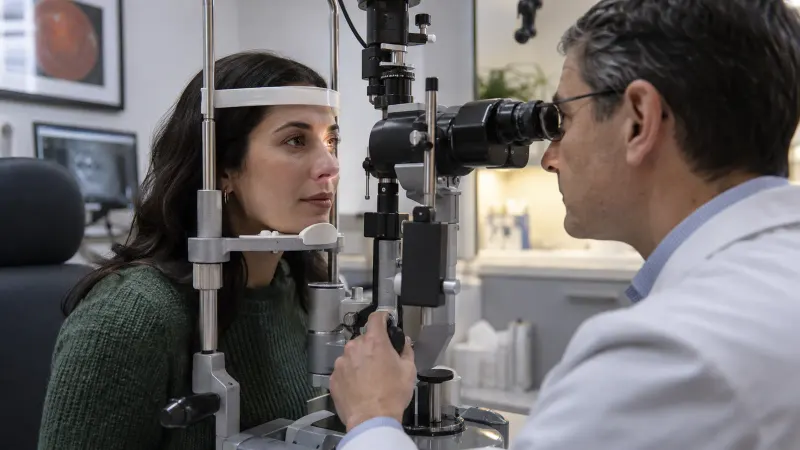

Many small superficial corneal abrasions improve substantially within a short period and can close over several days, but there is no safe universal deadline. Size, depth, cause, contact lens wear, retained foreign material, infection, dry eye, diabetes, and treatment adherence can lengthen healing. Pain often eases before the new surface is securely attached. If pain, light sensitivity, redness, discharge, or blurred vision is worsening rather than improving, the eye needs another examination. For a related symptom pattern, read Follow-up Monitoring for Salzmann Nodular Degeneration.
A clinician confirms healing with dye and magnified examination. Comfort alone cannot prove that the surface is closed.
The cornea repairs quickly because its surface renews
The epithelium is the cornea’s outer barrier. After a shallow scratch, nearby cells flatten, slide, and divide to cover the defect. Nerve endings are densely packed in this tissue, which explains why a small abrasion can be intensely painful.
New coverage is only the first stage. The cells must strengthen their attachment to the layer beneath. Rubbing, early contact lens wear, or an underlying adhesion problem can reopen the area.
Deeper injuries involve stromal tissue and are more likely to scar. Penetrating injuries are not abrasions and require emergency management.
Cause changes the expected course
A clean fingernail scratch is not identical to injury from soil, plant material, metal grinding, or contact lens wear. Organic material can introduce fungi. High-speed metal can leave an embedded particle and a rust ring. A lens wearer has a higher concern for microbial keratitis.
Chemical burns and ultraviolet injury can create epithelial loss but follow different treatment pathways. Recurrent erosion can cause morning pain long after an original scratch appeared to heal.
Tell the clinician exactly what touched the eye and what happened afterward. Exposure details can change medicine, follow-up, and testing.
A healing dashboard uses more than pain
Track the following signals together because no single symptom can confirm that the corneal surface has healed securely.
- Pain trend. It should generally become easier, not sharply worse after initial improvement.
- Light sensitivity. Persistent or increasing photophobia can signal ongoing surface injury or inflammation.
- Vision. Blur should be explained by tearing, ointment, or abrasion location and should not progressively decline.
- Redness and discharge. Increasing redness or purulent discharge raises infection concern.
- Surface finding. The examiner uses fluorescein staining to verify whether the defect is closing.
A single favorable signal does not cancel an unfavorable one. Less pain with worse vision still deserves review.
Why contact lens wear changes the rules
Contact lenses can carry organisms and alter the corneal environment. A lens-related abrasion can progress to infection, including infection by bacteria that can damage tissue rapidly.
Remove the lens and do not reinsert it until an eye-care professional confirms that healing and infection risk have been addressed. Bring the lens, case, and solution when asked.
Do not patch a contact lens-related abrasion at home. Do not use anesthetic drops outside supervised clinical use. They can mask worsening injury and interfere with healing when misused.
How does treatment protect healing and control risk?
Management may include lubricating ointment, antibiotic medicine, pain control, and follow-up based on the cause and size. A bandage contact lens is sometimes used by an eye professional with appropriate monitoring. It is not the same as putting a personal contact lens back in.
Some traditional practices are not appropriate for every abrasion. Patching is not routine for many simple cases, and leftover steroid combinations can worsen infection or delay recognition.
Follow the exact medicine schedule. If ointment blurs vision, plan safe transportation rather than skipping it.
Pain control can include oral medicine when medically suitable and clinician-directed drops that relax painful internal spasm in selected cases. The treatment chosen depends on examination findings. Do not combine products simply because each is sold without a prescription.
Work and school plans should account for temporary blur, light sensitivity, and the inability to wear contacts. Protective eyewear may prevent another strike while healing, but it does not replace activity limits after a significant injury.
A slower course has recognizable reasons
Large defects take longer to cover. Dry-eye disease, eyelid problems, diabetes, corneal dystrophy, reduced sensation, immune compromise, or repeated rubbing can slow repair or weaken attachment.
A foreign body under the upper lid can scratch the same area with every blink. Persistent vertical scratches may prompt lid eversion. An embedded particle or rust ring may require removal.
If symptoms plateau, the question is not simply whether to wait another day. It is whether the original diagnosis remains complete.
Why does location influence the experience?
A central abrasion crosses the visual axis and can blur vision more than a similarly sized peripheral scratch. A defect under the upper eyelid may hurt with every blink. Near the corneal edge, inflammation can resemble other painful red-eye conditions.
Location also affects examination. A very small central defect can be functionally important, while a larger peripheral area may preserve acuity. Clinicians use both size and position when setting follow-up.
Scarring risk increases when injury extends deeper than the epithelium or infection damages the stroma. That is another reason for prompt review when a white opacity appears.
Recurrent pain after apparent healing is a different problem
Some people wake with sudden pain weeks or months later because the eyelid pulls on loosely attached epithelium. This recurrent corneal erosion pattern can follow trauma or arise from a corneal dystrophy.
Long-term lubrication or additional treatment may be recommended. Repeatedly treating each episode as a brand-new random scratch misses the attachment problem.
Keep a record of timing, especially whether pain begins on first opening the eye in the morning.
Return sooner when the trajectory is wrong
Seek urgent review for a white or gray corneal spot, increasing pain, worsening redness, thick discharge, declining vision, fever, or inability to keep the eye open. A contact lens wearer or person injured by plant material should have a low threshold.
The guide to corneal abrasion versus infection explains why similar early symptoms can diverge. Corneal abrasion healing time is best understood as a monitored trajectory. The cause, examination, and direction of change matter more than reaching a particular day on the calendar.