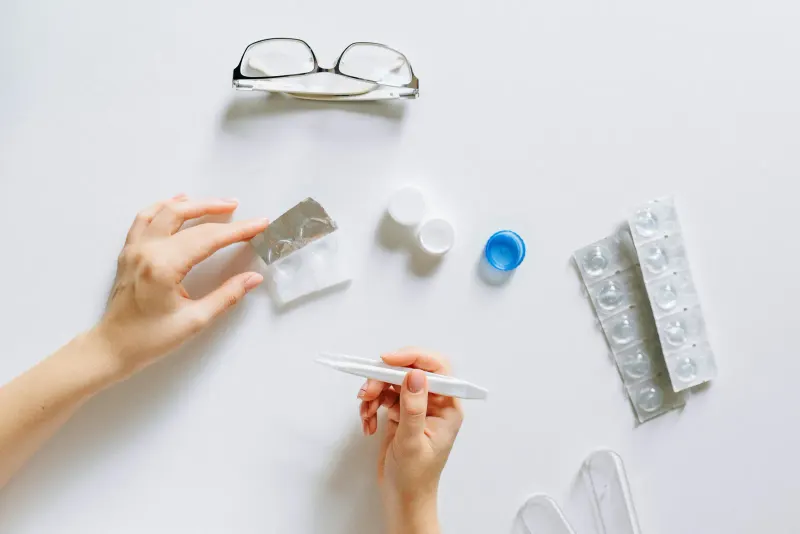

A suitable scleral lens filling solution is sterile, preservative free, intended for use around the eye, and specifically approved by the clinician managing the lens. It is poured into the bowl immediately before insertion and remains against the cornea during wear. That prolonged contact is why ordinary contact lens saline, multipurpose solution, preserved drops, water, and homemade mixtures should not be treated as interchangeable substitutes.
The safest choice comes from evaluating the exact product and the person wearing the lens. A broad recommendation cannot account for every corneal disease, allergy, lens coating, or treatment plan.
Filling liquid has one narrow job
The liquid creates a clear reservoir over the cornea. It does not replace nightly cleaning and disinfection. It does not make a dirty lens safe, and it does not neutralize a peroxide system.
Confusion often begins because several bottles use words such as saline, rinse, contact lens, or sterile. Those terms do not prove that a liquid is appropriate to remain beneath a scleral lens. Read the intended use and full directions rather than relying on the largest words on the label.
The Food and Drug Administration advises contact lens users to follow the product instructions and their eye care professional’s directions. That principle is especially important for a fluid reservoir with limited tear exchange.
Keep filling liquid separate from hydrogen peroxide systems. Peroxide cleaners must complete their full neutralization process in the supplied system before a lens reaches the eye. Putting unneutralized peroxide into the bowl can cause an immediate chemical injury. If a mix-up occurs, remove the lens and rinse the eye as directed by emergency or poison-control guidance, then obtain urgent professional advice.
The label screen catches the most important problems
Start with the package in your hand. If any answer is unclear, pause and ask the clinic.
- Does the label identify the liquid as sterile?
- Does it state that the formulation is preservative free?
- Is the container intact and within its use date?
- Does the product have directions compatible with filling a scleral lens?
- Has the fitting clinician approved this exact formulation?
A preservative-free claim alone is not enough. Grocery-store distilled water can be free of preservatives but is not a sterile eye product. A sterile wound rinse may not be labeled or formulated for ocular use. A multipurpose contact lens solution may disinfect lenses but contain ingredients that should not sit against the cornea all day.
Single-use and multidose packaging solve different problems
Single-use vials reduce repeated contact with one container, but the tip can still be contaminated if it touches a finger, eyelash, lens, or countertop. Discard the vial according to its directions rather than saving an open container simply because liquid remains.
Some preservative-free products use multidose packaging designed to limit contamination. Their safe use depends on the bottle system, storage, handling, and discard instructions. Do not assume that every multidose bottle has the same lifespan after opening.
Convenience matters only after safety and compatibility. A small container may travel well but be hard to open with limited dexterity. A larger bottle may be easier to handle but requires disciplined tip hygiene. Discuss the trade-off if packaging makes correct insertion harder.
Temperature and storage also matter. Do not leave solution in a hot car, freeze it, or use it after packaging damage. Travel supplies should remain in original labeled containers so security checks or a rushed morning do not separate a liquid from its directions.
Does electrolyte content or thickness matter?
Some users report differences in comfort or midday fogging between filling solutions. Formulation can matter, but symptoms do not identify the cause by themselves. Corneal health, reservoir depth, lens fit, tear debris, and ocular surface disease can all influence comfort and clarity.
A clinician may recommend adding a compatible preservative-free lubricant to the bowl for a particular ocular surface problem. That is an individualized instruction, not permission to experiment with gels or oils. A thicker mixture can change bubbles, vision, removal, and the way debris behaves under the lens.
Do not chase comfort by changing several variables at once. If you change the liquid, keep the lens, cleaning routine, and wear schedule stable when clinically safe. Record insertion comfort, wearing time, fogging, redness, and vision. A single controlled change gives the clinician more useful information.
A product switch deserves a short safety trial
The first goal is not to prove that the new product works. It is to notice whether the eye reacts poorly.
Check the eye and lens shortly after insertion. New burning, increasing redness, unexpected haze, or discomfort that repeats with the new liquid is a reason to remove the lens. Keep the package so the clinic can review ingredients and lot information.
Do not continue for days hoping the eye will adapt to a sharp reaction. Likewise, do not blame the liquid automatically if symptoms started after a lens fit change, illness, new medicine, or altered cleaning routine. Timing is evidence, not a diagnosis.
Never improvise when the usual supply runs out
Running out during travel or a shortage can tempt a risky substitution. The safe backup is a product already approved in the written lens plan. Ask the clinic to name more than one acceptable option before a trip.
Avoid these substitutions unless the treating clinician has explicitly directed otherwise.
- Tap, bottled, filtered, or distilled drinking water
- Homemade salt water
- Saliva
- Preserved artificial tears
- Redness-relief or allergy drops
- Multipurpose solution used as reservoir fluid
- Peroxide solution before complete neutralization
If no approved filling liquid is available, glasses are safer than an improvised reservoir. A missed day of lens wear is usually easier to manage than a preventable corneal infection or toxic reaction.
Match the solution to the eye, not to online popularity
People who wear scleral lenses for severe dry eye, corneal grafts, epithelial defects, keratoconus, or other conditions do not all have the same risk profile. Lens coatings and prescription treatments also differ. Recommendations from another wearer can provide questions, but they cannot replace the fitting record.
Readers deciding whether lenses are appropriate can review why dry-eye screening matters before contact lens wear. For current wearers, the practical rule is narrower. Choose scleral lens filling solution by verified sterility, absence of preservatives, compatible intended use, careful packaging habits, and approval for your specific eye.